

Riff—The Name of God Is Not a Permission Slip
On Blasphemy, 'No Quarter,' and the Theology of Dominative Christianism

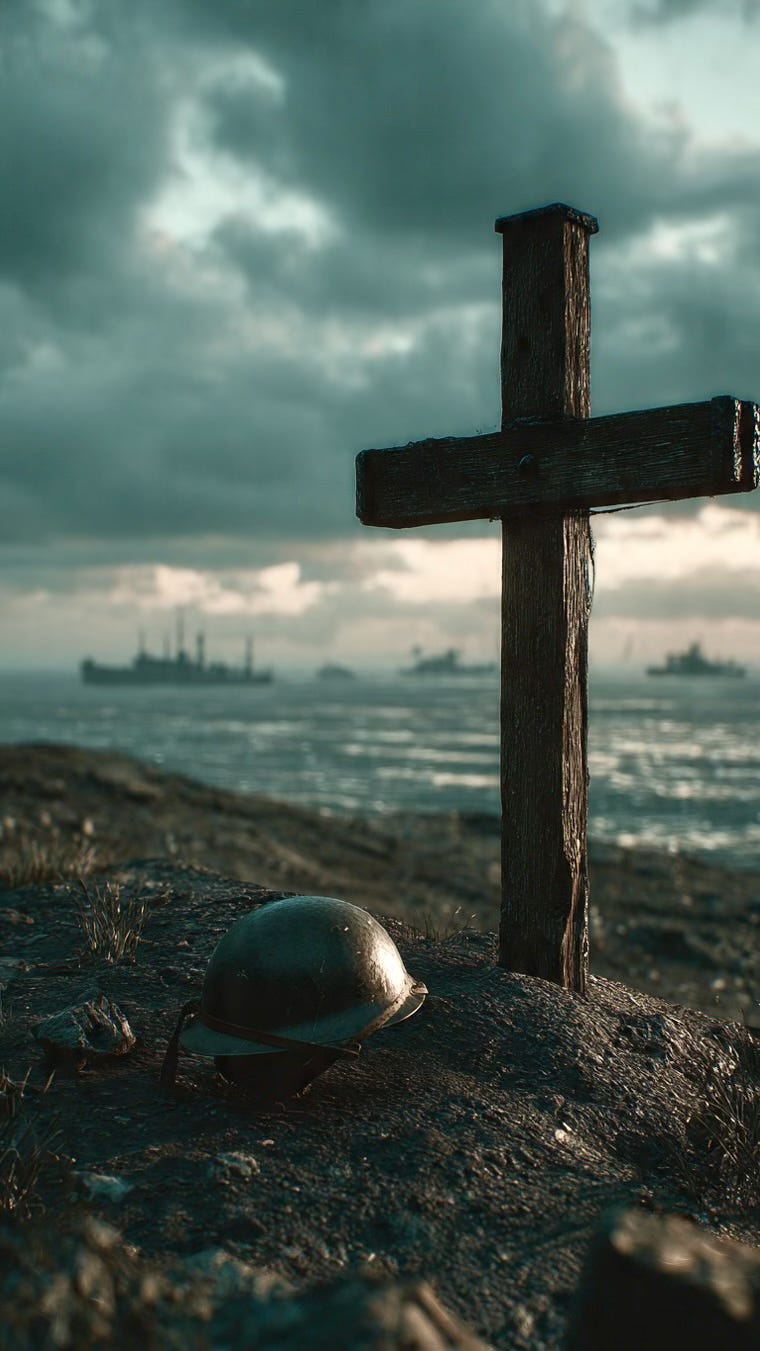
I want to say something carefully, because I am a theologian and a former naval officer, and both of those identities are demanding something of me right now.
My heart goes out to all those serving on ships in the Persian Gulf at this moment. I know what it is to be a young person in a steel hull far from home, doing what your country asks of you, trusting that the people above you in the chain of command have thought carefully about what they are asking. I pray for them. I grieve for the Iranian civilians — the children — caught in what is being done in our name. I hold both of these things, and I will not pretend they are easy to hold.
But I cannot be silent about what is happening with the name of God in these press briefings. That is not anger talking. It is the responsibility of ordination.
_
Secretary Hegseth has told us, repeatedly and without apparent embarrassment, that he prays for this mission every day. He has blessed our troops with the words “May Almighty God watch over you and His providential arms of protection extend over you.” He has told reporters that every recommendation to the President is made “prayerfully,” and that he prays for “biblical wisdom to seek what is right and the courage to do it.” He has said he serves God first, then the troops, then the country.
In the same press conferences — sometimes within the same breath — he has announced that U.S. forces will operate under “no stupid rules of engagement,” that he wants “maximum lethality, not tepid legality,” and, most recently, that there will be “no quarter, no mercy for our enemies.”
I want to dwell on that last phrase, because it is not rhetorical flourish. “No quarter” is a term of art in the law of armed conflict. It means no survivors. It means killing those who try to surrender. It has been prohibited under international law since the Hague Convention of 1899.
It was prosecuted as a war crime at Nuremberg. It violates the Geneva Conventions to which the United States is a party. It defies the Marine Corps’ own rules of engagement. Legal scholars at Just Security note plainly this week that the statement likely constitutes a violation of 18 U.S.C. § 2441 — the federal War Crimes Act.
And it was offered to us wrapped in prayer.
_
Theologians have a word for this. The word is blasphemy.
Not the casual cultural usage — not mere irreverence or profanity. I mean blasphemy in its precise, classical sense: the attribution to God of what God explicitly forbids. The invocation of the divine name as cover and sanction for what the divine name actually condemns.
The Hebrew prophets understood this pattern with terrible clarity. Jeremiah watched priests and prophets stand in the temple courts and cry “The temple of the Lord, the temple of the Lord, the temple of the Lord!” while the community devoured the poor and shed innocent blood. His response was not nuanced: Do not trust in these deceptive words. The issue was not that they prayed. The issue was what they were blessing while they prayed.
Amos did not think it was a compliment when he heard Israel’s liturgical enthusiasm. He rendered the divine verdict with the kind of precision that should make comfortable worshippers deeply uncomfortable: I hate, I despise your festivals, and I take no delight in your solemn assemblies. The worship was not being offered to God. It was being offered to the nation’s confidence in itself — and God’s name was being borrowed to seal the transaction.
This is what Dominative Christianism does. It does not merely make religion useful for politics. That would be cynicism, and cynicism is at least honest about what it is doing. Dominative Christianism is more ambitious: it genuinely believes that national power and divine favor are the same thing, that to bless American military supremacy is to bless God, that the prayer is real because the mission is righteous and the mission is righteous because the prayer is real. The circularity is the point. It is a closed system, and it is precisely that closure which makes it theological catastrophe.
_
There is something else here that I cannot pass over. Reports have now emerged — logged by the Military Religious Freedom Foundation across more than two hundred complaints at fifty military installations — that commanders have been telling soldiers, sailors, and airmen that the Iran war is part of God’s divine plan, that President Trump was “anointed by Jesus to light the signal fire in Iran to cause Armageddon and mark his return to Earth.”
This formation does not stop at the uniform. The Pentagon’s monthly prayer services, held under Hegseth’s direct sponsorship, have been communicated not only to military personnel but explicitly to defense contractors — the vast civilian workforce whose labor sustains these operations and who are now being formed by the same apocalyptic grammar as those who pull the triggers.
I will be direct: this is not Christianity. It is not a robust or vigorous or even misguided version of Christianity. It is the ancient heresy of holy war dressed in contemporary apocalypticism, and it is being preached to soldiers, sailors, airmen, and the civilians who build and maintain the machinery of war — all of them being told that to serve this mission is to serve God. It tells them that those they are killing are enemies of God. It removes from the entire operation every moral constraint — because once you have convinced yourself that you are God’s instrument of apocalyptic fulfillment, “no quarter” is not a war crime. It is obedience.
This is how blasphemy gets people killed. Not because it is impious. Because it is functionally totalizing. Because it fills the space where moral constraint is supposed to live.
_
I want to return to the soldiers and sailors and airmen and the contractors who support them, because they must not be lost in this argument. They are not the problem I am naming. They are among its victims.
They did not design these rules of engagement. They did not give these briefings. They did not choose to be sent into a war with a Secretary of Defense who publicly disdains the legal frameworks that exist precisely to protect them — because “no quarter” rhetoric does not only endanger Iranian combatants. It places American service members at greater risk of retaliation, of captivity without protections, of being tried for acts they were told were divinely mandated. Senator Mark Kelly, himself a combat veteran, said it plainly: this kind of language “would put American service members at greater risk.”
I pray for them with the specificity that comes from having stood watches in cold water, from knowing what it is to be twenty-three years old and very far from anyone who loves you. I pray for them without condition or qualification.
And I also know — as anyone who has worn a uniform knows — that the moral clarity of command matters. That the language of leaders shapes what happens in the dark, in the confusion, in the moment when a soldier or sailor must decide whether to fire. “No quarter, no mercy” is not a morale statement. It is a formation. It forms the moral imagination of those who hear it — uniformed and civilian alike — and what it forms is not courage but something far more dangerous.
_
One more thing, because it must be said: there are Iranian families tonight who are not our enemies in any theologically coherent sense of that word. There are children who will not wake up because of operations conducted in the name of God’s providential care for America. The strike on a girls’ school that killed more than one hundred seventy people — most of them children — occurred in the context of a campaign framed by prayer and providential nationalism.
The God of the Exodus did not liberate one people by destroying the children of another and calling it providence. The prophets knew that. The tradition knows that. Every serious Christian theology of just war — a tradition with which I have profound disagreements but also profound respect — knows that. The protection of civilians is not a bureaucratic constraint on righteous violence. It is a theological requirement rooted in the conviction that the people we are killing are also made in the image of God.
To pray for American troops while announcing no mercy for those they are sent to kill is not piety. It is a theological inversion so complete that the only honest word for it is blasphemy.
_
I do not say this to be inflammatory. Hauerwas taught me that the church’s first political task is to be the church — to tell the truth about what it sees, even when telling the truth is costly, even when it makes you unwelcome in rooms where the flag and the cross have been arranged to look like the same thing. I say it because I was ordained to say it.
The name of God is not a permission slip. It is not a public relations strategy. It is not something you invoke to consecrate what you have already decided to do for other reasons entirely.
The tradition I serve — the one that runs from Amos through Jeremiah through the apostle Paul through Augustine through the reformers through the best of the American prophetic witnesses — is unanimous on this point: when the name of God is used to bless what God forbids, the proper response of those who know God’s name is not silence. It is witness.
This is mine.
A note on the image: the header was generated with META AI. I think disclosure matters, particularly in a piece about the gap between appearance and reality.
Thank you for speaking up.