

Riff—Fidelity, Sir!
What Global Markets Are Quietly Telling Us About American Power

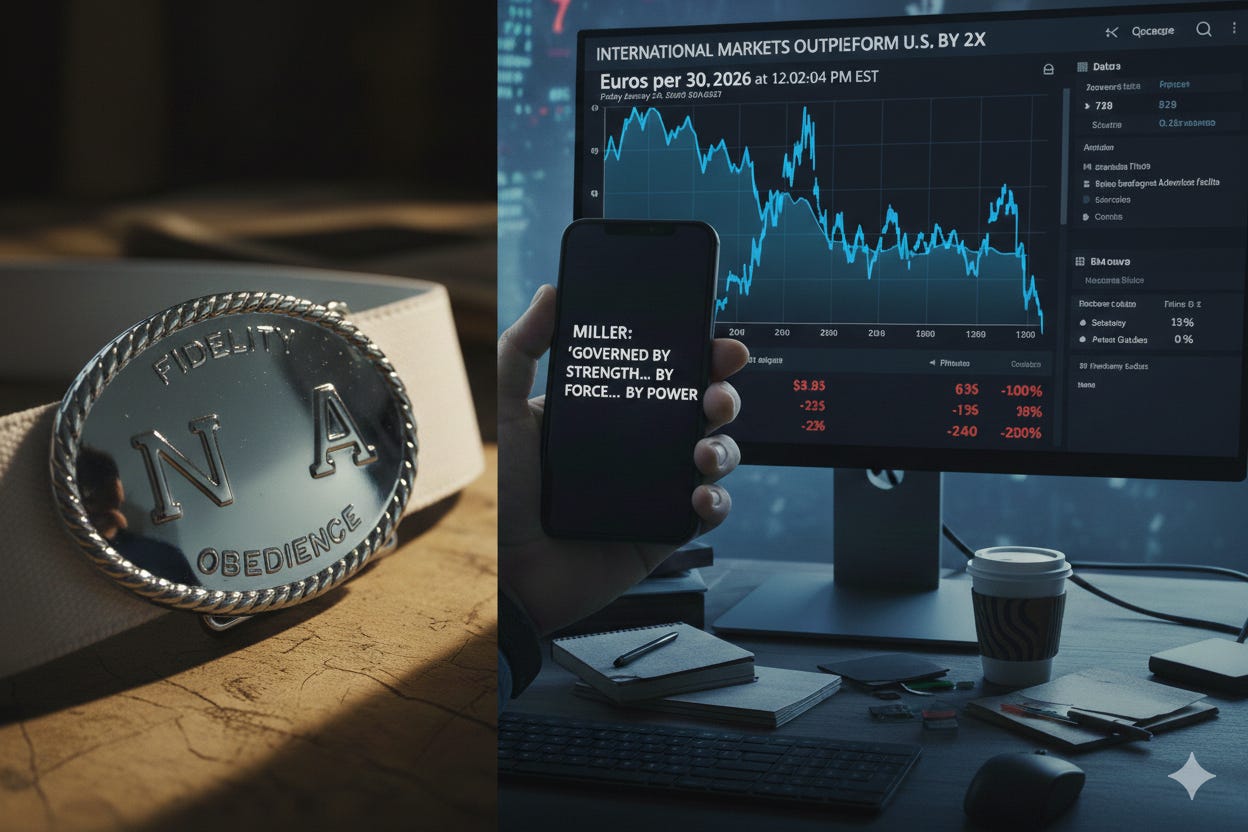
How odd to hear the president suggest this week that our stock market is endorsing his tactics. When I check my Schwab portfolio, I notice that international markets outperformed ours by nearly double in 2025 when adjusted for the falling dollar. We’re falling behind quickly.
I’ve been thinking about what global markets are actually pricing in. It’s not inflation. It’s not interest rate differentials. It’s trust.
The dollar’s status as global reserve currency has always rested on something simple: other nations believed American institutions would behave with fidelity and integrity. Those words live in my body differently than they might in yours. At Annapolis, they were stamped on the belt buckle we wore with full dress blues. Plebes knew the answer when an upperclassman barked “What’s up?”: Fidelity, sir! Four years of formation drilled it in—not as abstraction but as muscle memory, as identity.
So I feel something particular when I watch that fidelity and integrity collapse. Tariffs announced, reversed, escalated by tweet. Treaty commitments treated as suggestions. Bondholders informed their contracts may be abrogated. The rule of law—domestically and internationally—subordinated to loyalty tests. Allies treated not as partners but as vassals without choice.
And now the abandonment is explicit. Stephen Miller told CNN last month: “We live in a world that is governed by strength, that is governed by force, that is governed by power.”
I need to be honest: I know the seductions of force. I served on nuclear submarines. I’ve felt the thrill of wielding systems designed to end civilizations. There’s something intoxicating about power that doesn’t need to justify itself. So when I hear Miller’s words, I recognize them—not as alien ideology but as a temptation I’ve tasted.
And that’s what frightens me. It’s the anti-ideology of the raised fist. What strikes me is what’s missing from his statement. No appeal to democracy. To law. To mutual obligation. To the liberal order that made American hegemony possible. Just force as its own justification. I keep wondering: what happens to a nation when its leaders explicitly reject the idea that anything should constrain power?
The markets don’t care about ideology—or its abandonment. They’re running a cold audit: Can we still trust that American institutions will function with fidelity and integrity? And they’re reaching a verdict.
This is what it costs to replace fidelity and integrity with force. The satisfactions of dominance feel good in the moment—I know this in my bones. The tariff threats, the loyalty purges, the rule-breaking as performance. But the global system that made American power possible was built on something more boring: fidelity and integrity. And once squandered, they don’t come back on command.
Our retirement isn't abstract—it's the 2 a.m. number, the one I check when I can't sleep. Did the decades of discipline matter? Can we help our kids? Will there be enough? And what I see now isn't collapse—it's erosion. The rest of the world pulling ahead while our savings falls behind. Decades of betting on American fidelity, and we are losing ground to everyone who no longer trusts us. The president posts about winning. Winning what, exactly?
I don’t know where the bottom is. But I know what’s being gambled with—and it isn’t his money.