

Riff—Resistance, Grief, and Sacraments of Stupidity
On Doing Justice When Loved Ones Are Enchanted

Dear friends,
This is an essay about grief before it is an essay about resistance.
It’s written for those of us who love people we can no longer reach—people who speak in slogans where a person used to be, who defend what we recognize as cruel, who seem held by something that isn’t fully them anymore. If you’ve felt the pull toward contempt or withdrawal, I know that pull too.
What follows is not an attempt to win arguments or explain everything away. It’s an attempt to understand what has happened to the people we love, what is happening to us in response, and how to do justice without becoming what we oppose.
I. GRIEF
My friend James Howell published a Substack reflection today on Micah 6:8, unpacking the Hebrew with the precision it deserves.1 Darash—God doesn’t demand like a teacher requiring homework but yearns like a lover for response. Mishpat—justice isn’t fairness but care for those with no clout. Hesed—not niceness but covenant loyalty, rooted in Israel’s memory of being refugees themselves.
The prophetic word is clear. The Lord has shown us what is good.
But James’s post left me with a question he didn’t answer—couldn’t answer, perhaps, because it’s the question I have to live rather than resolve: How do I do justice, love kindness, and walk humbly when someone I love thinks the masked agents are heroes? When people I’m called to love are actively supporting what I recognize as sin?
I don’t mean strangers on the internet. I mean people whose faces I know in sleep.
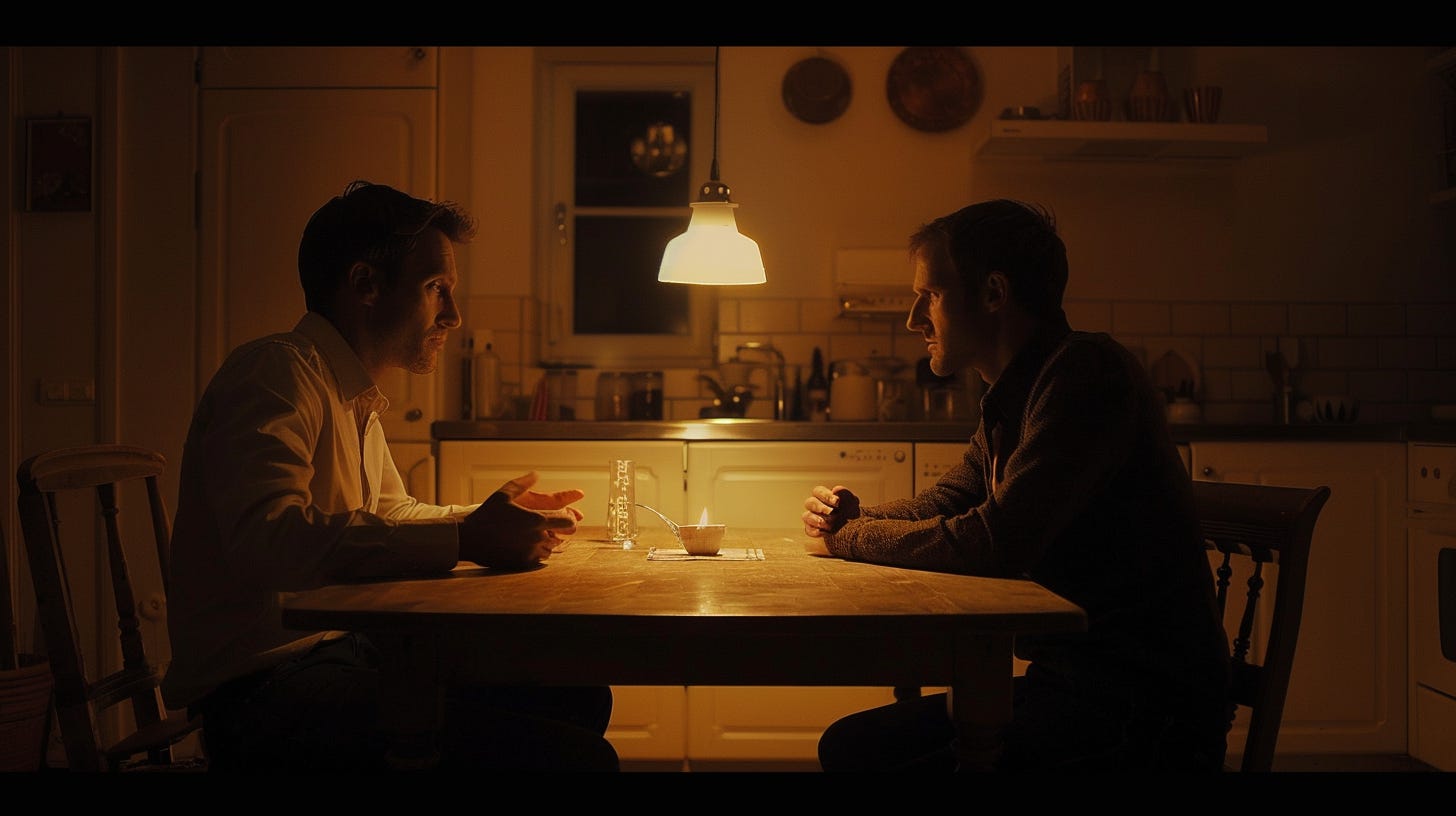
I know what it feels like to sit across the table from someone I love—a parent, a sibling, a friend—and hear slogans where a person used to be.
On Saturday morning, Alex Pretti—a 37-year-old ICU nurse at the Minneapolis VA hospital—was shot and killed by Border Patrol agents. Multiple verified videos show him holding a phone, not a weapon, as he tried to protect a woman who had been shoved to the ground. An agent removed Pretti’s legally holstered gun from his waist. Less than a second later, another agent opened fire. Ten shots in five seconds. Most were fired after Pretti was already motionless on the ground.
Within hours, administration officials labeled him a “domestic terrorist” who intended to “massacre” federal agents—claims so thoroughly contradicted by video evidence that even DHS officials now admit the messaging has caused “catastrophic” damage to agency credibility.2
His parents pleaded: “Please get the truth out about our son. He was a good man.”
I mention this to someone I love, and I hear: “Well, he shouldn’t have been there.” I describe the videos—the phone in his hand, the gun removed before the shooting—and I hear: “You can’t trust what the media shows you.” I name the administration’s lies, and I hear: “They’re just doing their jobs.”
Bonhoeffer described this exact experience: “In conversation with him, one virtually feels that one is dealing not at all with him as a person, but with slogans, catchwords, and the like that have taken possession of him.”3
That’s it. That’s what I feel. Something else is speaking through people I love.
I need to confess: I am ashamed.
Not that they voted for him initially. I can make room for that. People make mistakes. Information was incomplete. Hopes were misplaced. I understand initial error.
What I cannot comprehend is the persistence. After Alex Pretti was killed while the administration lied about what happened. After Renee Good was shot in her car three weeks earlier—also called a “domestic terrorist” before evidence showed otherwise.4 After masked agents pulled people from churches in El Paso. After the Venezuela extraction that even oil companies didn’t want, justified by reasons that kept shifting—drugs, then oil, then “running the country,” then oil again—because no reason was ever the real reason.5 After court orders defied. After all this evidence of what this regime is and does—they still defend it. Still call masked agents heroes. Still bend over backwards to name cruelty as strength. Still cling with what can only be called religious zeal.
The initial vote I can forgive. The clinging after evidence—that’s what breaks the heart.
And here’s what my shame wants: to discharge. The two available exits are contempt and withdrawal. Both promise relief. I have been tempted by both. Neither has brought me anywhere I want to live.
Dietrich Bonhoeffer knew something about this. At Christmas 1942, ten years into Nazi rule, he composed a circular letter to his fellow conspirators—his brother-in-law Hans von Dohnanyi, General Hans Oster, his friend Eberhard Bethge. These were men who had watched their nation become something unrecognizable. Men who loved Germany while Germany destroyed itself. Men who were plotting to assassinate Hitler—not writing from prison, not yet, but from the center of active resistance.6
Bonhoeffer named a danger I recognize: “The danger of allowing ourselves to be driven to contempt for humanity is very real—such contempt would lead to the most unfruitful relation to human beings, causing us to fall victim precisely to our opponents’ chief errors.”7
Precisely to our opponents’ chief errors.
It took me too long to notice: the Leader holds his followers in contempt. The lies are contempt performed. Every lie says: I don’t respect you enough to tell you the truth. I know you’ll swallow whatever I feed you.
Consider what happened with Alex Pretti. The administration called him a terrorist, a would-be assassin, someone intending to “massacre” agents—while videos clearly showed a man with a phone trying to protect a woman. They didn’t bother making the lie plausible. Why would they? Plausible lies are for people you respect.
The people we love didn’t start out this way. They were shaped into it—or they allowed it to happen, which Bonhoeffer says amounts to the same thing. The power of the Leader needed something from them, and the lies were the liturgy that created the bond.
This reframes the grief entirely. We’re not just mourning that someone we love supports evil. We’re mourning that they’ve been captured by someone who despises them. The Leader looks at our loved ones the way a con man looks at marks: with the affection a rancher has for cattle. And they, enchanted, declare the one who despises them a hero.
If we respond with our own contempt—if we let our shame discharge into attack or withdrawal—we complete the Leader’s work. We join him in despising the people we love.
He despises them. We will not.
II. DIAGNOSIS
Bonhoeffer’s letter “On Stupidity” is one of the most misused texts of our moment—circulating on social media as permission to call your enemies stupid. That’s not what he wrote. He wrote something far more unsettling.
“Stupidity is a more dangerous enemy of the good than malice,” he begins. Evil can be exposed, protested, resisted. Evil “always carries within itself the germ of its own subversion in that it leaves behind in human beings at least a sense of unease.” But against stupidity we are defenseless: “Reasons fall on deaf ears; facts that contradict one’s prejudgment simply need not be believed... and when facts are irrefutable they are just pushed aside as inconsequential.”8
Here is Bonhoeffer’s first crucial insight: what he calls stupidity is not an intellectual deficiency but a moral condition. “There are human beings who are of remarkably agile intellect yet stupid, and others who are intellectually quite dull yet anything but stupid.” The people we love and cannot reach are not unintelligent. The German Dummheit names not a failure of reasoning but a failure of perception—a moral obtuseness, an inability to see what is plainly visible.9
This is why argument fails. You cannot reason someone out of a condition that isn’t fundamentally about reason.
Bonhoeffer’s second insight cuts deeper: this condition is sociological, not psychological. It is produced, not innate.
“Every strong upsurge of power in the public sphere, be it of a political or of a religious nature, infects a large part of humankind with stupidity. It would even seem that this is virtually a sociological-psychological law. The power of the one needs the stupidity of the other.”
The Leader requires followers who cannot think independently, and the exercise of power produces such followers. The people we grieve did not arrive at their positions through deliberation. They surrendered deliberation. They gave up the work of establishing their own stance and let the power wash over them.
The result, Bonhoeffer says, is someone “under a spell, blinded, misused, and abused in his very being. Having thus become a mindless tool, the stupid person will also be capable of any evil and at the same time incapable of seeing that it is evil.”
If you’ve sat across the table from someone you love and felt that you were no longer talking to them—that something else was speaking through them—Bonhoeffer is naming your experience. And he calls it “diabolical.” I think he means it literally.

Sacraments of Stupidity
Let me name what the Leader is doing with theological precision.
The lies are not mistakes or exaggerations. They are sacraments of stupidity—liturgical acts that form the hearers into what the lies assume they already are.
A sacrament, rightly understood, is an outward sign that effects what it signifies. The bread and wine become, for us, the body and blood—not merely representing Christ’s presence but mediating it. The sacrament does something. It forms us.
The Leader’s lies are anti-sacraments: outward signs of inward contempt that effect what they signify. Where the Eucharist says, “This is my body, given for you,” the lie says, “This is my contempt, and you will swallow it.” And in the swallowing, the hearer is formed. Bound to the one who despises them.
This is why the lies are shameless, obvious, and constant. Their brazenness is the point. A plausible lie might be believed for reasons; a shameless lie can only be swallowed through submission. Each lie accepted is an act of capitulation. The lies are not trying to convince. They are trying to form. They are the liturgy of a counter-church, and those who consume them are being catechized.
Rogers Brubaker gives this dynamic its sociological precision.10 Populist discourse operates in a two-dimensional space—simultaneously vertical (us vs. elite) and horizontal (inside vs. outside). The Leader doesn’t just provide enemies; he provides a coordinate system. “The people” invokes three registers at once: the disrespected ordinary folk (recognition), the sovereign citizens whose power was stolen (restoration), and the threatened community (protection).11
When your loved one swallows the obvious lie, they’re not failing an intelligence test. They’re locating themselves in a space where you—with your arguments, your evidence, your appeal to reason—have been positioned as simultaneously “on top” (condescending) and “outside” (not really one of us).
And the shamelessness of the lies? That’s not a bug. Brubaker describes populism’s “low” style—raw, crude, warm, unrestrained—as the deliberate rejection of elite norms of polite discourse.12 The Leader relishes violating the rules that mark you as educated, cultured, one of them. Every shameless lie is a performance of belonging to us. And when the follower swallows it despite knowing better—because it’s outrageous—they perform their own counter-belonging. They demonstrate that they value solidarity over the epistemological niceties that the condescending elite prizes.
But why would anyone submit to this? Why would the people we love surrender their inner independence to someone who holds them in contempt?
Because many of them carry shame—some personal, some the felt humiliation of being looked down upon by coastal elites, educated progressives, the people who seem to run everything and sneer at people like them. This shame is real. Cultural contempt has been directed at certain populations for decades, and they have felt it, absorbed it, been wounded by it.
Donald Nathanson mapped the options decades ago.13 When shame becomes unbearable, we can withdraw, avoid, attack ourselves, or attack others. The Leader’s genius—and it is genius; we gain nothing by pretending otherwise—is to channel the shame of millions into coordinated attack-other. The protectionist rhetoric doesn’t just identify threats—economic, cultural, securitarian.14 It legitimizes the rage that shame-saturated nervous systems already crave to discharge. Your enemies are real. The threat is existential. Your rage isn’t dysfunction—it’s patriotism.
The Leader offers relief. Not healing—relief. The rallies give permission to discharge shame outward rather than bear it inward. The lies are permission structures for rage. The brazenness baptizes the shame discharge.
The people we love are medicating wounds with poison. The dealer despises his customers. This is not incidental to the business model.
Understanding this changes our posture. We are not facing villains. We are facing captives.
But here Charles Mathewes offers a crucial warning: we must not try too hard to understand.15 The problem with our approach to evil, Mathewes argues, is not that we fail to comprehend it but that we presume we should—that we treat evil as a smooth thread in our moral fabric rather than what it actually is: “a tear, a black hole.”
This is why arguing with captured loved ones fails. We keep trying to comprehend their position—to understand it well enough to refute it. But this very attempt to comprehend is the error. Their position is not comprehensible because it participates in evil’s essential unworldliness.
Mathewes proposes instead what he calls “practices of incomprehension”—active refusal to integrate evil seamlessly into our moral understanding. This is not ignorance but discipline.
And this is liberating: You don’t have to understand how your loved one could defend agents who killed Alex Pretti and the leaders who lied about it. In fact, you shouldn’t. The exhausting work of trying to comprehend can be set down. Not because you’re giving up on them, but because comprehension was never the right approach.
I have practiced this, badly and incompletely. Sitting at a table where someone I love repeated the administration’s lies about Minneapolis, I felt the old urge rise—to marshal evidence, to construct the airtight refutation, to make them see. This time I didn’t. I said, “I see that differently,” and then I asked about his grandchildren. Something in me felt like surrender. It wasn’t. It was the recognition that argument had become my way of not being present—a performance of rightness that guaranteed I would never actually be with him. We talked about his grandkids’ schools and soccer seasons for twenty minutes. I don’t know if it mattered to him. It mattered to me.
Mathewes names a double movement that structures our grief:
First, making the alien familiar: My loved one’s capture participates in a story I know—the false story where we’re the protagonists, where communion is optional equipment, where autonomy is achievement rather than exile.16 I am susceptible to that story too. We have not been tested the way they have been tested. If we had walked their paths, worn their skin, carried their shame—would we have resisted? This prevents the contempt that comes from treating them as fundamentally other.
Second, making the familiar alien: The person speaking in slogans is genuinely foreign to authentic human existence. What we encounter when engaging our captured loved one is genuinely not them—it is displacement from reality. The person we knew is absent in some real sense. Grief is appropriate.
Now I can name what has not worked—in my own attempts and perhaps in yours.
Argument has not worked. Bonhoeffer told me this would happen: “Never again will we try to persuade the stupid person with reasons, for it is senseless and dangerous.”17 You cannot reach someone who has surrendered the capacity for independent judgment.
Withdrawal has not worked either—what Bonhoeffer calls “withdrawn contempt.”18 Good people “withdraw in disgust from people and leave them to themselves, who would rather tend to their own gardens than debase themselves in public life.” But withdrawal is contempt wearing the mask of self-care.
And idealization has not worked. We tell ourselves we love them for who they could be. Bonhoeffer saw through this: “a sincerely intended love for humanity that amounts to the same thing as contempt for humanity. It rests on evaluating human beings according to their dormant values.”19 Loving who someone could be while despising who they actually are is still contempt.
All three responses fail the incarnational test. All three are ways of not showing up.
Bonhoeffer offers one more hard truth: “Only an act of liberation, not instruction, can overcome stupidity... genuine inner liberation becomes possible only when external liberation has preceded it.”20 Our arguments cannot free our loved ones because the power structure that holds them has not yet been broken. The work right now is not convincing them. The work is resisting the power that captured them—and maintaining relationship until liberation comes.
He despises them. We will not.
III. THE WAY
So what remains? If argument is useless, withdrawal is contempt, idealization is fantasy, and comprehension is the wrong mode entirely—what is left?
Howell’s Micah returns, but now the question has changed. How do we do justice when someone we love is enchanted and nothing we say will break the spell? How do we love kindness when kindness feels like capitulation? How do we walk humbly when we’re certain—certain—that we see what they cannot?
The humility is the hardest part. Bonhoeffer insists: “Nothing of what we despise in another is itself foreign to us.” The capacity for capture is human. Which means it is ours.
Bonhoeffer pairs “On Stupidity” with a companion letter: “Contempt for Humanity?” The question mark matters. He is asking whether contempt is the appropriate response—and answering no.
“The only fruitful relation to human beings—particularly to the weak among them—is love, that is, the will to enter into and to keep community with them. God did not hold human beings in contempt but became human for their sake.”
Here is the christological ground that transforms everything.
The incarnation is not a strategy God employed to fix a problem. It reveals what was always true. God’s face doesn’t turn away—not because we needed God not to turn away (though we did), but because turning away has never been God’s nature. The mutual gaze that constitutes Trinity doesn’t break when met with human refusal.
Christ on the cross—bearing full exposure, experiencing complete disconnection from humanity’s side—shows that God remains with us even in the most separating, alienating, annihilating circumstances. Not conquering death, not defeating sin, not reversing anything—but being-with us through it all. As Sam Wells puts it, the incarnation reveals that God’s primary posture is not working for us or even working with us, but simply being with us—presence that does not require outcomes to be meaningful.21
This means that when we refuse contempt for those we love, we are not simply being nice. We are participating in the divine life. We are being conformed to Christ. To refuse contempt is to align with what is most real.
And we can only do this because it has first been done to us. We can only stay present because we’ve been given presence. We can only refuse contempt because we’ve been shown what love looks like on a cross. This is not achievement; it is gift received and passed on.
But why does contempt fail not just ethically but actually? Here is where the metaphysics matters. Hart reminds us that God is not a being among beings but Being itself—the inexhaustible source in which all creatures participate.22 Persons are not reducible to what they do or fail to do; they are constituted by their participation in this source. The captured loved one who parrots the Leader’s slogans remains a creature whose being flows from the God who is Being itself. To treat them with contempt—to reduce them to their capture—is to commit the same ontological error the Leader commits. He sees them as marks. We must not see them as villains.
The Leader’s contempt is not merely cruel; it is nihilistic—a reduction of persons to their use-value, which is to say, to nothing. Our refusal of contempt participates in the divine affirmation that creatures are—that being is good, that persons are ends, that existence is gift. This is not ethics. This is ontology.
To embrace contempt—to complete the Leader’s work by joining his disdain—would be to align with the nihilism, to join the reduction. We are choosing which reality we will inhabit.
He despises them. We will not.
James Bernauer, reflecting on both Bonhoeffer and Hannah Arendt, names what sustains this posture: amor mundi—love of the world.23
This is not optimism. Bernauer is clear: we love the world “not because there is an ideological vision of its potential perfection, but because it is greater than the storms of evil which pass over it.”
The storms are real. Minneapolis is real. Alex Pretti is dead and the lies continue. The masked agents are real. We do not deny the evil. But the world—including our captured loved ones as part of that world—is greater than the storms passing over it.
This requires courage, not confidence. Loving the world that includes people who defend state violence is not naive. It is brave. It costs something. It might fail. But it is the posture that keeps us human when everything invites us to become mirrors of what we resist.
Bonhoeffer called this “this-worldliness”—Diesseitigkeit.24 We do not withdraw from captured loved ones into otherworldly consolation. We live “unreservedly in life’s duties, problems, successes and failures, experiences.” The messy reality of relationship with them—their current captivity included—is where faith is learned. Not in escape but in presence.
But what does this look like practically? “Being with” sounds lovely in a theology seminar. What does it mean at a dinner table?
I have been learning, slowly and poorly, some postures for the long haul.
Presence without persuasion. Show up. Sit at the table. Do not arrive with arguments prepared. When they speak in slogans, do not engage the slogans. Ask about the garden. Hold the grandchildren. Remain in the room when everything in you wants to leave. And when they cross a line, say quietly: “I see that differently.” Then stop. Do not explain, justify, or defend. Register the witness and let it sit.
Solidarity with suffering. Bonhoeffer says we must learn to regard human beings “less in terms of what they do and neglect to do and more in terms of what they suffer.” The people we grieve are suffering—the shame that made them vulnerable to the lies is real, and it hurts them. We cannot heal that shame. But we can refuse to add to it. When my loved one starts in on the latest outrage, I sometimes see something flicker behind his eyes—something that looks like exhaustion. The rage is work. Even he is tired of it.
Patience measured in years. The spell may not break while we are alive to see it. This is the risk of incarnational presence—it does not guarantee results. God tried it and ended up on a cross. We are not responsible for outcomes. We are responsible for presence.

The Fifth Option
The incarnational alternative is costly. Bearing shame without discharging it—neither attacking those we love nor withdrawing from them—is cruciform work.
Nathanson mapped four options when shame becomes unbearable: attack others, attack ourselves, withdraw, or avoid.25 Every one of these is a way of not staying in the exposed place. Every one is movement away from the shame rather than through it.
The cross reveals a fifth option: exposure. Bearing the shame without discharging it. Standing in the place of vulnerability and refusing to move.
This is what the incarnation looks like when it meets our moment. Christ did not attack those who shamed him. He did not withdraw into divine invulnerability. He did not avoid the confrontation or turn the shame inward into self-destruction. He stayed. He bore the full weight of humanity’s rejection without converting it into counter-rejection.
The resurrection does not undo this exposure; it vindicates it. The one who bore shame without discharge is revealed as the one who was right all along. The exposure was not weakness but the shape of divine love meeting human refusal.
This is what I am asking of myself—and perhaps of you. Not to pretend we’re not ashamed. Not to attack those who make us ashamed. But to bear the shame with them, as Christ bore it with humanity. To stay in the exposed place. To let the grief be grief without converting it into contempt.
The Counter-Liturgy
What sustains this? Not willpower. Willpower runs out before Thanksgiving.
We are sustained by the community that practices the counter-liturgy. The Leader’s lies are sacraments of stupidity—outward signs of contempt that form hearers into consumers of disdain. The Eucharist is the counter-sacrament—an outward sign of self-giving love that forms us into a body capable of refusing contempt.
On Sunday, we receive bread and wine. The true sacrament. The sign that effects what it signifies: communion with God and with each other across every division. But notice what the Eucharist is doing against the Leader’s liturgy:
Where his lies say, “This is my contempt, and you will swallow it,” the Eucharist says, “This is my body, given for you.”
Where his sacraments form people into isolated consumers of rage, the Eucharist forms us into a body—members of one another, including the ones we grieve.
Where his liturgy requires enemies, the Eucharist makes present the One who prayed for his executioners.
The Eucharist doesn’t just form us in a different grammar. It makes present the One who refused contempt unto death. Every time we receive, we are rehearsing the refusal this letter calls for. We are being formed into people capable of bearing shame without discharge, of staying present when everything in us wants to flee, of loving those who have been captured by someone who despises them.
The person we’re grieving may be at the same table. This is not a problem to be solved; it is the shape of the practice. The Eucharist does not wait until we have sorted out who deserves to be there.
We are sustained by prayer—not as technique but as orientation. Pray for them by name. Not that they would agree with us, but that they would be free. That the spell would break. That their inner independence would be restored.
We are sustained by hope that is not optimism. We do not know that they will be liberated. But we know that the One who joined us in our captivity is also the One who breaks every chain. We know that resurrection follows crucifixion, even when the Saturday stretches longer than we can bear.
What does the Lord require? To do justice, to love kindness, to walk humbly with your God.
How do we do that when the people we love are enchanted?
We stay. We witness. We grieve. We practice incomprehension—refusing to make evil comprehensible while remaining present to those it has captured. We exercise amor mundi—loving the world that is greater than the storms passing over it. We refuse the contempt that would make us mirrors of what we resist. We bear the shame without discharging it. We receive the counter-sacrament that forms us in a different grammar. We wait for a liberation we cannot produce and may not see.
The Leader despises them. He lies to them because he holds them in contempt, and the lies make them what he always assumed they were.
We will not look at them that way. We will not complete the liturgy of disdain. We will not join the one who enchanted them in holding them beneath regard.
He despises them. We will not.
This is our resistance. This is our grief. This is our sacrament.
CODA
Alongside the main arc of this series, I’ve been writing a handful of short riffs—ad hoc pastoral reflections responding to particular moments in our common life. They’re not steps in the argument so much as pauses for presence: ways of staying human and regulated when events outrun our capacity to think them through all at once.
If you need them, they’re there:
Riff: The Data We Create by Looking — on how systems of evidence can remain rigorously blind to the suffering they exclude, and why that blindness matters for everything that follows.
Riff: Make the Coffee Slowly — a pastoral pause on regulation, kindness, and staying human when fury feels justified but corrosive.
Riff: The Art of Fugue and the Art of Staying Human — on music, presence, and the practices that help us remain capable of faithful action amid moral overload.
None of these are prerequisites for the main essays. They’re simply companions—offered for moments when the work asks more than you have capacity to carry, or when the times themselves demand a different register.
The Series
This essay belongs to Jazz, Shame, and Being With—a twenty-essay arc tracing shame and pride from neurobiology through theology to political formation. If you’ve been reading along, you know where we’ve been. If you’re new, or if you’d like to see the architecture of where this is heading, the Reader’s Guide maps the full journey. Every essay is a real door. Start anywhere that calls to you.
If this work has helped you notice your own formation, subscribing is one way to stay with the conversation. Biweekly essays on incarnational alternatives to Dominative Christianism, drawing on embodied psychology, theology, and jazz. Presence, not opposition.
ENDNOTES
James Howell, “Micah of Minneapolis,” James’s Substack, January 26, 2026, https://revjameshowell.substack.com/p/micah-of-minneapolis. Howell is the Senior Pastor at Myers Park United Methodist Church in Charlotte, North Carolina.
The timeline and details of Alex Pretti’s killing are drawn from video analysis by ABC News, The Washington Post, NBC News, and Reuters. See “A minute-by-minute timeline of the fatal shooting of Alex Pretti by federal agents,” ABC News, January 26, 2026; “Videos show agent secured gun from Pretti before fatal shooting,” The Washington Post, January 25, 2026. Administration officials—including DHS Secretary Kristi Noem, White House deputy chief of staff Stephen Miller, and Border Patrol Commander Gregory Bovino—labeled Pretti a “domestic terrorist” who intended to “massacre” agents. These claims were contradicted by multiple verified videos. Fox News reporter Bill Melugin reported on January 26 that DHS sources expressed “extreme frustration” with officials making claims “even after numerous videos appeared to show those claims were inaccurate.” One DHS official told CBS News: “When we gaslight and contradict what the public can plainly see with their own eyes, we lose all credibility.”
Dietrich Bonhoeffer, “On Stupidity,” in Letters and Papers from Prison, Dietrich Bonhoeffer Works, vol. 8, ed. John W. de Gruchy, trans. Isabel Best et al. (Minneapolis: Fortress Press, 2010), 43–44. Written as part of his reflections “After Ten Years,” composed for fellow conspirators at Christmas 1942. All Bonhoeffer quotes on stupidity in this essay are from this letter.
Renee Nicole Good was shot and killed by ICE agent Jonathan Ross on January 7, 2026. Administration officials initially labeled her a “domestic terrorist.” Witness accounts reported agents called her a “fucking bitch” as she lay dying. Subsequent video evidence raised questions about the official narrative.
On the Venezuela extraction and shifting justifications, see Timothy Snyder, “Thinking About...” Substack, January 5, 2026. Snyder wrote: “This act of war is more about regime change in the United States than it was about anything in Venezuela.”
The “After Ten Years” section of Letters and Papers from Prison was written as a circular letter at Christmas 1942 to Bonhoeffer’s fellow conspirators in the resistance against Hitler: his brother-in-law Hans von Dohnanyi (a key figure in the Abwehr conspiracy), General Hans Oster (deputy head of the Abwehr), and his close friend and biographer Eberhard Bethge. At this point, Bonhoeffer was not yet imprisoned—that would come in April 1943. He was writing from within the active conspiracy.
Dietrich Bonhoeffer, “Contempt for Humanity?,” in Letters and Papers from Prison, Dietrich Bonhoeffer Works, vol. 8, ed. John W. de Gruchy, trans. Isabel Best et al. (Minneapolis: Fortress Press, 2010), 46–47. All Bonhoeffer quotes on contempt, withdrawal, and idealization in this essay are from this companion letter to “On Stupidity.”
Dietrich Bonhoeffer, "On Stupidity."
The German Dummheit derives from Old High German tumb, meaning mute, deaf, or simple. It carries connotations closer to “dullness” or “obtuseness” than the English “stupidity,” suggesting a failure to perceive rather than a failure to reason—moral blindness rather than intellectual incapacity. Robert Musil lectured on intelligente Dummheit (intelligent stupidity) in Vienna in 1937, naming it a Gefühlsfehler—an error of feeling rather than thought.
Rogers Brubaker, “Why Populism?,” Theory and Society 46, no. 5 (2017): 357–385. Brubaker argues against “purified” definitions of populism that separate its vertical dimension (people vs. elite) from its horizontal dimension (inside vs. outside). The intertwining, he insists, is constitutive rather than contingent. See also his extended treatment in “Populism and Nationalism,” Nations and Nationalism 26, no. 1 (2020): 44–66.
Brubaker identifies three valences of “the people” in populist discourse: plebs (the common people demanding recognition against those who look down on them), demos (the sovereign people demanding restoration of power), and bounded community (the nation or ethnos demanding protection). The productive ambiguity across these registers is not conceptual sloppiness but the practical resource that makes populist appeals powerful. “Why Populism?,” 364–367.
Brubaker, “Why Populism?,” 375–376. He writes that populist style “favors the raw and crude (but warm and unrestrained) over the refined and cultivated (but cool and reserved),” and crucially: “Populists not only criticize the rules governing acceptable speech: they relish violating those rules.” The violation itself performs authenticity and belonging.
Donald L. Nathanson, Shame and Pride: Affect, Sex, and the Birth of the Self (New York: W.W. Norton, 1992), 305–377. Nathanson’s “compass of shame” maps four responses to unbearable shame: withdrawal, avoidance, attack self, and attack other. The cross reveals a fifth option the compass doesn’t map: exposure—bearing shame without discharge.
Brubaker’s analysis of protectionism’s three forms (economic, securitarian, and cultural) maps onto Nathanson’s shame-discharge dynamic: each provides socially sanctioned targets for the attack-other response. Crucially, Brubaker notes that elites are blamed not only for condescension but for being “overly solicitous of those on the bottom”—allowing shame-rage to flow both upward and downward simultaneously. “Why Populism?,” 371–373.
Charles Mathewes, A Theology of Public Life (Cambridge: Cambridge University Press, 2007); see also Evil and the Augustinian Tradition (Cambridge: Cambridge University Press, 2001). Mathewes argues that evil should remain “a tear, a black hole” in our moral understanding rather than something we integrate comprehensibly.
This language draws on my earlier essay “The Gift of Shame: A Theology of Receiving” (Essay 5 in this series), where I describe sin as “the story where we’re the protagonists, where communion is optional equipment, where autonomy is achievement rather than exile.” The cross doesn’t fix this; the cross reveals what was always true.
Dietrich Bonhoeffer, "On Stupidity."
Dietrich Bonhoeffer, "Contempt for Humanity?"
Dietrich Bonhoeffer, "Contempt for Humanity?"
Dietrich Bonhoeffer, “On Stupidity.”
Samuel Wells, Constructing an Incarnational Theology: A Christocentric View of God’s Purpose(Cambridge: Cambridge University Press, 2025). Wells argues that the incarnation reveals God’s fundamental posture toward humanity: not working for, not working with, but being with—presence that does not require outcomes to be meaningful. See also Wells, Incarnational Ministry: Being with the Church (Grand Rapids: Eerdmans, 2017), and A Nazareth Manifesto: Being with God (Oxford: Wiley-Blackwell, 2015).
David Bentley Hart, The Experience of God: Being, Consciousness, Bliss (New Haven: Yale University Press, 2013), 28–35, 127–152. Hart articulates the classical theist understanding that God is not a being among beings but Being itself—the inexhaustible source in which all creatures participate. Creaturely existence is constituted by this participation; persons are not reducible to what they do.
James Bernauer, “Bonhoeffer and Arendt: Worldliness, Christians, and the Limits of Philosophy,” in Being Human, Becoming Human: Dietrich Bonhoeffer and Social Thought, ed. Jens Zimmermann and Brian Gregor (Eugene, OR: Pickwick Publications, 2010). The phrase amor mundi is drawn from Hannah Arendt; Bernauer shows its resonance with Bonhoeffer’s “this-worldliness.”
Bonhoeffer, letter to Eberhard Bethge, July 21, 1944, DBWE 8:486. Bonhoeffer describes “this-worldliness” as “living unreservedly in life’s duties, problems, successes and failures, experiences.”
Donald L. Nathanson, Shame and Pride: Affect, Sex, and the Birth of the Self (New York: W.W. Norton, 1992), 305–377. Nathanson’s “compass of shame” maps four responses to unbearable shame: withdrawal, avoidance, attack self, and attack other. The cross reveals a fifth option the compass doesn’t map: exposure—bearing shame without discharge.
Powerful writing and thought provoking! Can relate but would not have been able to put these thoughts into words. Thank you for the thoughtful and loving ideas and suggestions. Much to ponder.