

Riff—The Grammar That Needs an Enemy
How Dominative Identity Works—From Ishmael to "Failed State Imports"

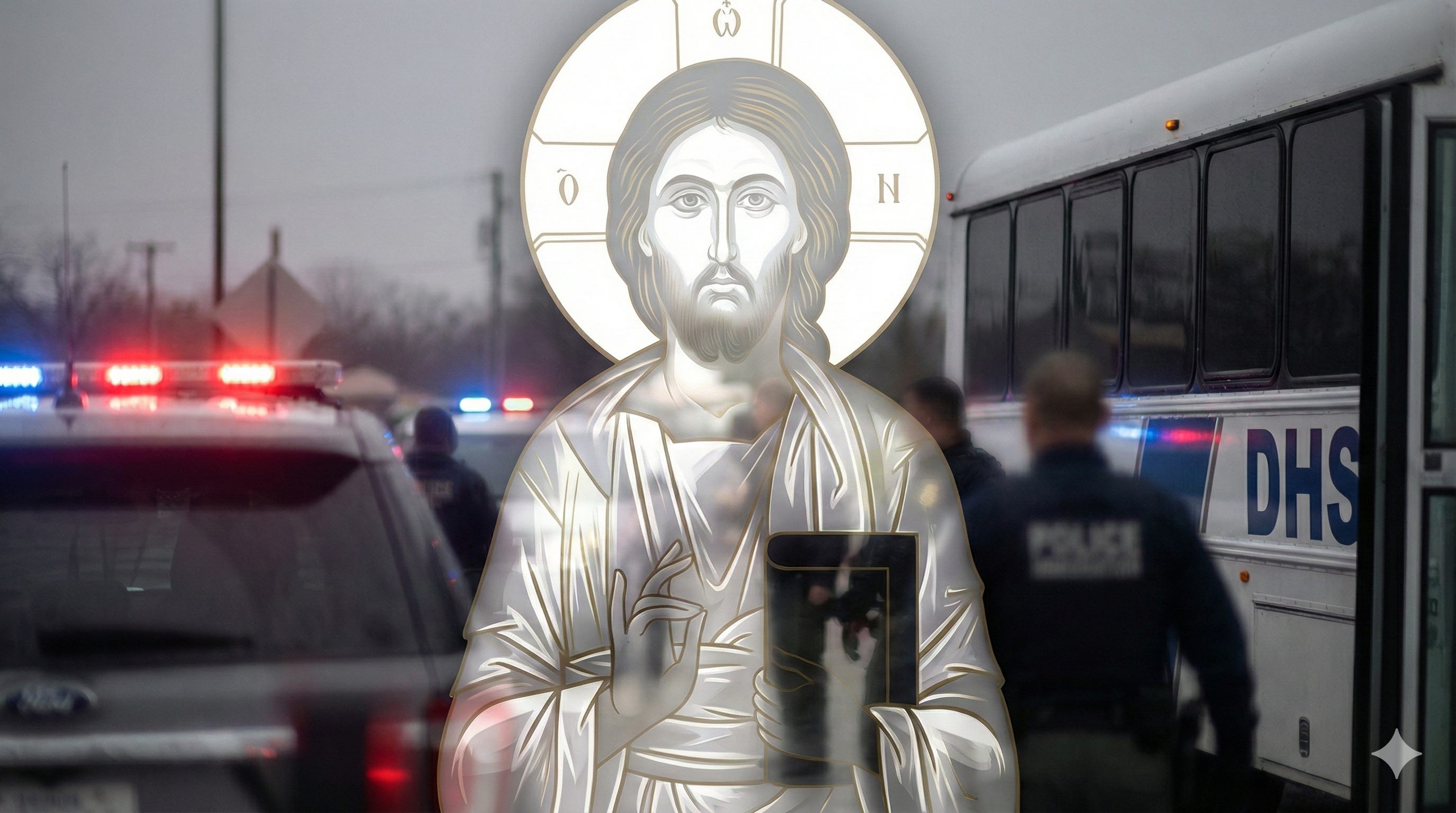
I’ve been developing a concept across this series that I’ve called dominative identity—the self that requires a threatening “them” to know who “we” are. The “we” is constituted by what it excludes.
I recognize this pattern because I’ve felt its pull myself. The security that comes from knowing who’s “in” and who’s “out.” The comfort of clear boundaries. The relief when anxiety about my own belonging gets transformed into certainty about who doesn’t belong.
Then I read a post by biblical scholar Dan Hawk, and I watched the apparatus operate in real time.1
Hawk exposed how certain Christian voices draw a direct line from the biblical Ishmael—Abraham’s son through Hagar—to modern Arabs and Palestinians. They treat this manufactured “genealogy” as if it establishes permanent, divinely-ordained enmity. Historic Adversaries were meant to exclude or subdue.
The problem? There’s no credible historical or biblical warrant for the connection. The descendants of Ishmael listed in Genesis no longer exist as identifiable peoples. So where does the Ishmael-to-Arab genealogy come from? The Hadiths—Islamic tradition. The same Christians who reject Islamic authority on everything else have imported this particular claim because it serves their purposes.
The theological function is what interests me. This manufactured genealogy creates a category of person who can never belong, whose origin permanently disqualifies them, whose removal fulfills the restoration of what was “ours.”
The criterion sounds biblical—who wouldn’t want to be on God’s side?—but it’s designed so Palestinians always fail. Their displacement isn’t tragedy; it’s prophecy fulfilled.
The grammar doesn’t require theology to operate.
Watch what happens when the same structure gets secularized. The current regime doesn’t need convictions about Ishmael. It needs objects for resentment—populations whose very existence can be framed as threat.
The vocabulary shifts. “Ishmaelite” becomes “failed state import.” “Historic Adversary” becomes “imported society.” “Outside the covenant” becomes “unable to assimilate.” But the grammar is identical.
Stephen Miller’s language is instructive. When he speaks of immigrants from “failed states,” he’s not making a policy argument. He’s making an ontological claim: these people carry the failure in themselves. The failure is genealogical. It travels in the blood.
I’ve been a student in this curriculum too. The messages didn’t come labeled as ideology. They came as common sense, as prudence, as “just being realistic” about who belongs and who doesn’t. The training is ambient. You breathe it before you can name it.
You don’t have to look to Gaza to see this grammar working. It’s operating in American zip codes right now.
Minneapolis. Operation Metro Surge moves through the Somali neighborhoods of the Twin Cities. Ahmed, who has run a grocery store in Cedar-Riverside for twelve years, is no longer a neighbor. He’s an “imported society” from a “failed state”—as if the political failures of a country attach permanently to the bodies of people who fled it.
Springfield. As I write this, the February 3rd deadline for Temporary Protected Status termination is hours away. Marie, who has worked as a nursing assistant in Ohio for six years, is being severed from her legal standing. This isn’t a policy dispute. It’s ritual enactment: she must be removed so that “Heritage America” can reclaim its inheritance.
Dearborn. During the 2024 campaign, the Arab Muslim community was courted as “moral allies.” That alliance was a bait-and-switch. The neighbors in Dearborn discovered what the conversos of fifteenth-century Spain already knew: you can be brought inside, but can you ever really be trusted? The answer, by design, is always no.
Three theaters. One grammar. The criterion for belonging keeps shifting, but the structure remains.
This is fascist, not merely nativist: the targeted populations are instrumental. They’re not the ultimate enemy; they’re the training material.
The regime doesn’t primarily hate Somalis or Haitians or Palestinians. It hates the political order that says these people have rights. Every “failed state import” is a proxy for the politics that would welcome them. Dehumanizing the immigrant delegitimizes the worldview that would protect them.
The performative brutality—the raids, the buses, the children separated—isn’t inefficiency. It’s pedagogy. The regime is forming its base to see neighbors as threats.
Dominative Christianism provides the theological cover: these are “Ishmaelites,” historic adversaries, obstacles to prophetic fulfillment. Secular nationalism provides the political cover: these are “failed state” entities, unassimilable, threats to “our way of life.” Different vocabularies. Same grammar. Both serve the deeper purpose: training citizens to accept that some people simply don’t count.
Jesus of Nazareth consistently broke through ethnic boundaries. He treated Samaritans, Syrophoenicians, and Roman centurions as neighbors to be loved, not historic adversaries to be expelled. He told a story in which the Samaritan—the religious Other—was the one who showed mercy.
Dominative Christianism doesn’t drift away from this example. It requires actively refusing to follow it.
And here’s the irony: the same theology that uses “biblical” genealogy to exclude Palestinians has quietly severed Jesus from his own Jewish story. A Christ severed from Israel isn’t the Messiah—because “Messiah” means Israel’s anointed king. Sever the covenant, and you’re left with a generic savior who can be filled with whatever content your culture provides. The generic savior is infinitely flexible precisely because he’s infinitely empty. He demands nothing because he is nothing in particular.
They don’t need Jesus of Nazareth. They need a mascot. Mascots don’t talk back. Mascots don’t have opinions about the border. And mascots are never, ever Jewish in any way that matters—or a refugee in Egypt, for that matter.
The apparatus I’ve been tracing across this series—dominative identity and its enforcement mechanisms—isn’t historical curiosity. It’s loading buses in Ohio. It’s checking papers in Minneapolis. It’s retracting the “we” in Michigan the moment the votes are counted.
And it’s forming Christians to accept all of it as faithful obedience.
Ahmed is a neighbor. Marie is a neighbor. The family in Dearborn who thought they’d been welcomed—they’re neighbors. Not archetypes, not “failed state” entities, not obstacles to prophetic fulfillment. Actual human beings with the same status before God as anyone else.
That’s the simplest claim I can make. And apparently it’s radical enough to constitute heresy—because they’re practicing a different religion entirely, one that has borrowed Christian vocabulary while serving a god who requires enemies to exist.
Maybe that’s always been the tell.
ENDNOTES
Daniel Hawk, Facebook post, February 2026, https://www.facebook.com/share/p/1HXANGTwcU/. Hawk demonstrates that there is no biblical warrant for connecting Ishmael’s descendants to modern Arabs—the connection derives from Islamic tradition (the Hadiths), which Christian Zionists ironically import while rejecting Islamic authority on all other matters. My analysis extends Hawk’s critique of this theological maneuver to show how the same grammar operates in secularized form within what I call Dominative Christianism—a politicized ideology using Christian language and symbols to justify dominance over society’s institutions, representing theological apostasy that instrumentalizes faith for political power rather than embodying Christ’s kenotic pattern.