




Dear friends—
Here’s the short version: Essay 7 is about pride, but not the kind most of us were warned about. It asks whether pride might be a gift—not the hubristic drive to stand above others, but the courage to contribute from what we’ve received.
What I learned in writing this is unsettling: my formation misunderstood both shame and pride in ways that still shape me. This essay goes back to Augustine, the Cappadocians, Aquinas, Luther, and the hidden curriculum of my own life to see what the tradition actually taught—and what we turned it into.
If you’ve ever felt torn between the desire to offer something meaningful and the fear of being seen, this may help name that tension. The fuller exploration begins below.
A Phone Call Home
I called my mother from Duke to confess unfaithfulness.
Not the kind she might have expected. I had fallen in love with Augustine of Hippo—a Catholic saint. In my tribal imagination, this bordered on betrayal. The boundaries had been clear since childhood: Marianne from St. Joseph’s Academy was gorgeous, could waterski like a dream, but Mom forbade dating her. “She’s Catholic,” she said, as if that settled everything. It did. Like St. Joseph’s, “St. Augustine” meant one of theirs, not one of ours.
Yet here I was, a grown man at divinity school, calling to confess that a fourth-century North African bishop had rocked my world. That I had found in his Confessions what I couldn’t find in the Christianity of my youth: permission to be restless. Permission to not have it all figured out. Permission to approach God with something other than achievement.
I knew there was no going back.
Mom laughed. She always did have more grace than her tribal language suggested. But the phone call marked something real: I was beginning to discover that the Christianity I’d inherited might not be the Christianity. That what I’d been taught about pride and shame and how to become a worthy self might represent a mutation rather than the tradition itself.
The Question
The previous essay left me with a problem. If shame operates as biological firmware—an ancient alarm system that can’t be quieted through achievement—then what do I do with the Christianity that formed me? The one that taught me to “be the gift” through heroic service? The one that measured spiritual maturity by how much I could contribute, how little I needed to receive, how completely I could transcend dependence on others?
But as I sat with that question, another one emerged underneath it. What if the problem wasn’t pride itself but what we’d done with it?
In the fourth essay, I argued that shame is a gift—biological firmware designed to call us back to communion when we drift. What if pride is also a gift? Not the hubristic kind that needs to dominate, but something else entirely—the courage to contribute, the capacity to recognize that what we’ve received is worth offering back?
If that’s true, then my formation didn’t just misunderstand shame. It also distorted pride—turned a gift into a grasping, made contribution into competition, replaced the courage to offer with the compulsion to prove.
Was my faith itself at odds with what I was learning about shame and pride? Or had I inherited something else entirely—a mutation that wore Christian clothes but operated by different logic?
I needed to go back to the sources. To find out whether the tradition itself understood what my formation had missed.
Augustine: The Restlessness That Won’t Quit
I expected Augustine to pile on the guilt. He has that reputation—the architect of original sin, the man who supposedly invented Western sexual shame. I braced myself for more of what I’d grown up with: the problem is you, try harder, do better.
Instead, I found the most famous line in Christian autobiography: “Our hearts are restless until they rest in You.”1
Not: “Our hearts are wicked until we fix them.” Not: “Our hearts are deficient until we achieve enough.” Restless. A word that describes a condition, not a crime. Something in me recognized it immediately—that constant hum beneath all my accomplishments, the nagging sense that more was never enough.
Augustine knew that restlessness couldn’t be quieted by achievement. He had tried. Professor of rhetoric in Milan, climbing the imperial ladder, succeeding by every measure that mattered—and the restlessness only intensified. He was experiencing what I would later recognize as the firmware problem: disordered shame operating below the level where accomplishment could reach it.
What struck me most was his distinction between two kinds of self-love. There’s amor sui—the curved-inward love that makes the self its own ultimate reference point. And there’s caritas sui—proper self-care that flows from first being loved by God. The first generates what we’d now call hubristic pride: defensive, comparative, needing to outperform others to feel secure. The second generates authentic pride: grounded in reception, capable of genuine contribution precisely because it isn’t scrambling for worth.2
But here’s what haunted me: Augustine saw something that my formation had missed entirely. He noticed that consciousness of your own moral effort could itself become a subtle form of that curved-inward love. You could be so focused on your own spiritual achievement that even your humility became a source of pride. Even your service became about you—about what you were accomplishing, what you were contributing, who you were becoming.
Augustine’s diagnostic marker was gratitude—or rather, its absence. Amor sui can’t really receive because receiving threatens its self-sufficiency. It can take, acquire, even accept—but it can’t receive in the way that acknowledges dependence.
I saw this at my parish every Maundy Thursday after I implemented the foot-washing rite. Each person would arrive at the basin, wash the feet of the one seated, then sit to have their own feet washed. Many enjoyed washing their friends’ feet—generous, serving, in control. But when they sat and someone knelt before them, I watched them grow agitated. They could give but not receive. The Eucharist that followed asked the same thing of them: come with empty hands, receive bread and wine, be fed before you serve. Some found it easier to wash feet than to be fed.
Peter’s protest to Jesus—You shall never wash my feet!—wasn’t humility. It was pride dressed as deference, the self-sufficient self, so threatened by grace that it would refuse communion rather than receive it.
Self-sufficiency all the way down.
I recognized myself in that description. All those years of heroic service, and I was terrible at receiving help. Terrible at being served. Terrible at the genuine gratitude that acknowledges: I needed that, and I couldn’t have provided it for myself.
Augustine showed me the curvature. The Cappadocians showed me what we were curving away from.
The Cappadocians: From Dependence to Coinherence
Nobody taught me about the Cappadocians in Sunday school. Basil of Caesarea, Gregory of Nyssa, Gregory of Nazianzus—fourth-century bishops who hammered out what Christians actually mean when they say “Trinity.” I discovered them at divinity school and they began to upend everything I thought I knew about dependence and identity.
My formation had taught me that dependence was weakness. The goal was to need less—less from others, less from circumstances, less from God except in appropriately spiritual ways. Maturity meant self-sufficiency. The “gift” I was supposed to become was defined precisely by its independence: not needing, only giving. The truly strong person stood alone.
Gregory of Nyssa shattered this with a single metaphor. To explain how Father, Word, and Spirit relate, he made an analogy to human thought and speech.3 The mind frames its thoughts in words; the content is identical, but thought and word are different realities. And a thought, even when formed into words, remains unexpressed until spoken—until breath transforms the inner word into the reality of sound. Gregory played creatively with the Greek pneuma, which means breath, wind, prophecy, and Spirit all at once. The Spirit is the breath that transforms God’s Word into the concrete reality of creation.
Sitting in the Duke Divinity library, I felt something crack open. Here was a framework where the persons of the Trinity were distinguished not by competitive self-sufficiency but by their relationships to one another. Thought needs word needs breath. Each one is what it is only in relation to the others. This wasn’t the self-sufficient isolation I’d been trained toward. It was a vision where identity came through relationship, where “dependence” on another wasn’t weakness but the very structure of divine life.
Sam Wells helped me see how far this goes.4 The tradition calls it “coinherence”: each person of the Trinity constituted by relationship to the others. Not a chain of command. Not one person existing first and then producing the others. Each one wholly containing and being contained by the others while remaining distinct.
Think of it this way: the Father is not the Father before or apart from having the Son. The Son is not the Son apart from the Father. There’s no protected core of autonomous selfhood hiding behind the communion—no private self that exists first and then chooses to relate.
Barth said it plainest: God is “never-to-be-except-to-be-with-us.”5
The relating is the being. Relationship all the way down.6
The Cappadocians weren’t naive about disordered dependence—the kind that manipulates, that refuses to grow, that burdens others unfairly, that makes another person responsible for our whole sense of self. But they distinguished this from the mutual indwelling that constitutes love itself. You can’t love without being with. You can’t be in genuine relationship without the kind of porosity that lets another in. The self-sufficient self, needing nothing from anyone, isn’t the goal of spiritual maturity. It’s a theological impossibility—a fiction we construct to protect ourselves from the vulnerability that is love’s basic grammar.
What my formation had celebrated, I was learning, was what I’ve come to call disordered pride—the hubristic kind that needs to stand alone, that can’t receive without feeling diminished, that measures worth by independence.7 The competitive self, the self that must be the source of its own significance, the self that experiences every gift as a threat to its autonomy. The Cappadocians—and the tradition that flows from them—offered something different: an imagination where being-with is glory, not shame. Where the persons of the Trinity find “exultant joy” in each other, not anxiety about their status. Where receiving doesn’t diminish but constitutes.
I didn’t learn this in Sunday school because it would have been incomprehensible to the imaginative world I was being formed into. How do you explain coinherence to someone trained to think that selves must be either autonomous or determined by another? How do you describe mutual indwelling to someone whose imagination can only conceive agency as competing or cooperating, never as participating?8 The Cappadocians weren’t just teaching a doctrine about God. They were proposing an alternative imagination of what it means to be a person at all—one where relationship isn’t something added to pre-existing selves but is the very ground of selfhood. Where receiving isn’t weakness but the structure of divine life itself.
The Cappadocians showed me what we were made for. Aquinas showed me how it works—and why my formation had gotten it backwards.
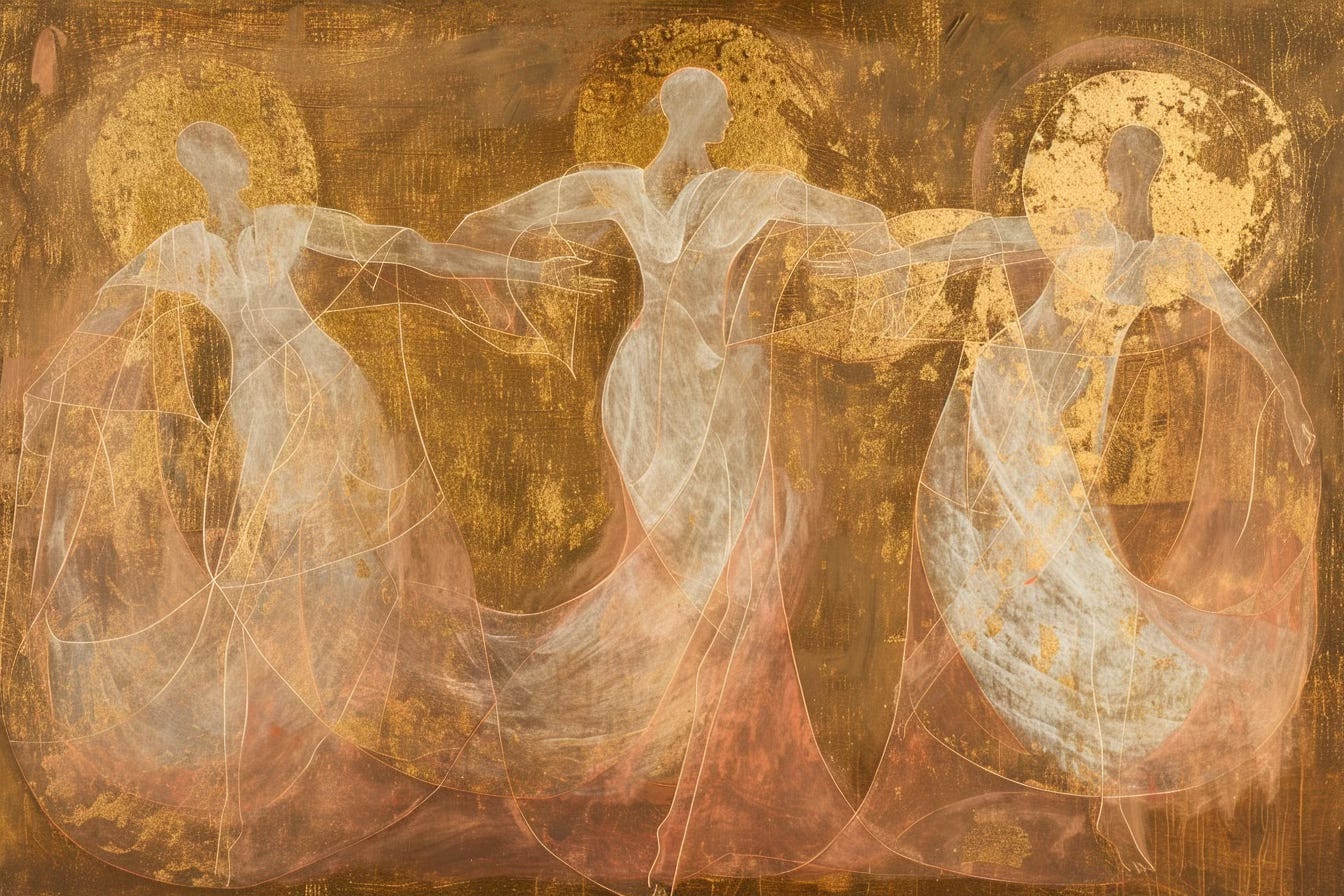
Aquinas: The Grammar I Knew But Didn’t Inhabit
He looks at the human person standing in that field of divine generosity and asks: What does agency look like when it grows from secure belonging rather than fear? His answer is the unlikely pairing of humility and magnanimity.
Magnanimity, in Aquinas’s hands, is not the modern virtue of being big-hearted; it is the greatness of soul that dares to attempt things worthy of the gifts God has given. Humility is not self-negation; it is the clarity that those gifts are received rather than manufactured—that the factory I’d been running all my life could finally close.
For Aquinas, these two belong together the way roots belong to branches. Humility holds the self in truth; magnanimity lets the self stretch toward its vocation. One grounds; the other rises.9
Aquinas believed the virtuous person was the one whose life unfolded from this integration—who acted from a foundation already given. And modern psychology, for all its different vocabulary, recognizes the same pattern: secure belonging allows for non-defensive agency. The child steadied by love becomes the adult who can take risks without the terror of exposure—perfect love casting out fear.
Here’s the strange thing: I knew this. I could have passed an exam on Aquinas’s virtue theory. I understood, at least intellectually, that magnanimity and humility were compatible rather than opposing—that they “proceed according to different considerations,” as Aquinas put it. Magnanimity looks at what God has given; humility looks at our own weakness. You need both. I could recite the formula: magnanimity works “in consideration of the gifts he holds from God.”
But the operating system running underneath was something else entirely.
What my formation actually practiced, without ever naming it, was a layperson’s version of what David Hume celebrated in the eighteenth century. Hume was explicit about rehabilitating pride as the engine of moral motivation. He called “love of glory” and “magnanimity” the “shining virtues” and dismissed humility as a “monkish virtue” worthy of the column of vices. For Hume, pride wasn’t dangerous—it was indispensable.10
We would never have said that. But we practiced it.
The difference between Aquinas and Hume isn’t obvious on the surface. Both affirm genuine excellence. Both reject false humility. Both value greatness of soul. The difference is where the pleasure lands.
For Aquinas, magnanimity is oriented toward action—toward contributing from what’s been given. The focus is outward: What is there to do? What does my vocation demand? Gratitude isn’t a threat to this agency; it’s the ground of it.
For Hume, pride is oriented toward self-survey—toward the pleasure that arises from contemplating your own excellent character. The virtuous Humean is sustained by the pleasure she takes in being the kind of person she admires. The focus is reflexive: How do I look when I look at myself?11
My formation said Aquinas but practiced something else entirely—a folk philosophy of self-sufficiency that I’ve only recently learned to name. From Hume (or his descendants): the proud self taking pleasure in its own excellence, virtue as the engine of agreeable self-regard. From Kant (or his descendants): the autonomous self anxious that reception would compromise agency, dependence as a threat to dignity. From the American air we breathed: the self-made self, measured by achievement, owing nothing to anyone. These don’t cohere philosophically—Hume and Kant would have despised each other’s systems—but they cohered in practice. They all pointed the same direction: away from receiving, away from dependence, away from the gratitude that admits you needed something you couldn’t provide for yourself.
The church should have been the community that formed me into a different story. That’s the indictment. We didn’t absorb this folk philosophy despite our Christian formation. We absorbed it through our Christian formation—in Sunday school, in sermons, in the unspoken curriculum of who got honored and why. We affirmed that gifts come from God while running on these other engines entirely. We knew the right answers about humility while privately keeping score. Appear humble—that’s good manners. But the pride is the engine. The humility is performance.
And gratitude? Gratitude exposed the counterfeit most clearly. For Aquinas, gratitude fits seamlessly with magnanimity because both grow from the same root: the truth that excellence is received. But in the folk philosophy I was actually formed in, gratitude was a subtle threat. If my worth comes from received gifts, I can’t take the same reflexive pleasure in surveying my own achievement. Gratitude disrupts the mechanism. So we performed gratitude—we said the right words, we muttered praise toward God at the appropriate moments—while something underneath quietly registered the achievement as ours.
Aquinas called gratitude “a debt of love from which no man should wish to be free.” That phrase stopped me when I first encountered it. In my formation, debt was precisely what we wished to escape. The self-sufficient self needs no debt, owes nothing, stands free. We were being trained to resent the very debt that Aquinas said no one should wish to escape.12
I was beginning to see my formation clearly. We had the grammar of Aquinas in our mouths and the mechanism of Hume in our hearts. We could mouth soli Deo gloria while the self-survey hummed along underneath, registering our excellence, building the character we could admire upon reflection. No wonder the restlessness never quieted. Pleasurable self-regard is a hungry god that never stays fed.
Aquinas showed me the counterfeit I’d been running. Luther diagnosed how deeply it had curved me.
Luther: The Curve You Can’t Uncurve
I discovered Luther’s phrase incurvatus in se years ago, but I didn’t feel it until recently. The self curved inward on itself. Everything bending toward self-reference. I knew it as doctrine. I didn’t recognize it as autobiography.13
A beloved church history professor at Duke, Warren Smith, had a way of making Augustine unforgettable. When he taught us about pride—Augustine’s superbia—he didn’t just explain it. He demonstrated it. He bent over in his chair, curled his shoulders forward, and stared down at his own belly button. “Navel-gazing,” he said. “When your eyes are on your navel, they can’t be on God.”
The room laughed. But the image stuck. I’ve used it in parishes ever since, and it’s never failed to land. There’s something immediately recognizable about it—the posture of someone so absorbed in examining themselves that they’ve lost sight of everything else. The anxious self-scrutiny that crowds out wonder. The endless internal inventory that leaves no room for the Other.
That was Augustine’s insight, Professor Smith explained. And Luther extended it. Even our best efforts curve back toward the question we can’t stop asking: How am I doing? Am I enough yet?
John Bradshaw taught me to notice toxic shame’s disguises. I started seeing them everywhere—including in a parishioner reporting with evident satisfaction after her recovery meeting: “I was the worst perfectionist there.” Even her confession had become a competition. The curvature had bent her humility into another form of self-display. Every achievement, every service, every theological insight—all of it curving back toward self-concern. The performance of humility that is its own subtle pride. The confession that secretly expects applause. The spiritual discipline undertaken to prove something about myself rather than to encounter God.14
For years I credited Luther with the core insight. My professors taught me that Luther recovered Augustine’s diagnosis after centuries of Dominican scholastic optimism had softened it. The Thomistic synthesis, the story went, had domesticated the radical Augustinian critique of human capacity—and Luther called us back to the uncomfortable truth of our self-curved condition.
There’s truth in that narrative. But it’s not the whole truth. And the part it leaves out matters enormously for understanding how we got where we are.
The diagnostic does originate with Augustine. In City of God, Augustine identifies superbia—pride as fundamental disorder—as the root corruption pervading even pagan virtue. The magnanimous person’s refusal of gratitude, denial of dependency, aspiration to godlike self-sufficiency: this is the curvature Luther would later name. Even virtues “reckoned by some people to be genuine and honourable,” Augustine writes, “when they are related only to themselves and are sought for no other end... are puffed up and proud, and so are to be accounted vices rather than virtues.” Everything curves back toward the self.15
So Luther was right to recover this. Luther wasn’t inventing; he was remembering.

What I Couldn’t Hear
Here’s the embarrassing part. My professors at Duke included Hauerwas, Wells, Campbell, Carter, Smith, Kavin Rowe—the very scholars whose insights now finally germinate were planting seeds in well-prepared soil. Except the soil wasn’t prepared. It was concrete. They handed me the cure and I took careful notes, passed my exams, and walked away with the disease intact.
They told me. I couldn’t hear it. The operating system was already running, and it had no category for what they were offering. I could write papers on participatory righteousness while still trying to earn my place in the seminar. I could recite Campbell’s critique of the courtroom gospel and then preach it anyway. The self-curved self is remarkably efficient: it can curve even its own theological education back toward self-improvement.
So let me be precise about what I couldn’t receive: Augustine himself was not “hyper-Augustinian.”16 He diagnosed the self-curved condition, yes. But he also prescribed a cure—and the cure wasn’t simply staring harder at oneself while feeling bad about it.
Augustine left ample room for gradual process and transformation. He absorbed pagan spiritual exercises into Christian life, chastened by humble recognition of dependency. Through scripture, Eucharist, prayer, confession, Christians are renewed in God’s image. Eyes that had been fixed inward slowly learn to lift. This is habituation, even if Augustine rarely used the term. Augustine knew the therapy, not just the diagnosis.
And Aquinas—far from softening Augustine’s insight into comfortable accommodation—actually preserved what Augustine practiced while adding crucial conceptual architecture. Bowlin has shown me that Aquinas already understood what Porges and Siegel would need laboratories to confirm: virtue requires the soil of friendship and community; the soul can only act freely when its identity is not at stake in its own action. Secure belonging enables our gaze to lift. When you’re not anxiously wondering whether you measure up, you can finally look at something—someone—other than yourself.17
Aquinas called it “pious magnanimity”—greatness of soul that knows its greatness is gift. You can attempt great things precisely because you’re not trying to prove anything. And his vision of how God works in us isn’t a zero-sum game where every point for God is a point taken from you. Grace doesn’t replace your action; it enables it. God’s hand doesn’t shove yours aside—it steadies it, the way a parent steadies a child learning to draw. The child is still drawing. More freely than before, because she’s no longer afraid of getting it wrong.
How the Well Got Poisoned
This is where I need to be careful. David Steinmetz—who taught me Luther and Calvin at Duke—spent his career distinguishing reformers from their receptions. He would not let me get away with blaming Luther for what Luther’s heirs made of him.
But let me be honest: I think the seed was in the soil. Luther’s formal theological architecture—crystallized in his polemical writings and systematized by subsequent generations—created a framework where divine and human action appeared to compete. The more God does, the less we do. If God saves us, we contribute nothing. If we contribute anything, we’re trying to save ourselves. His heirs didn’t betray Luther. They found what was already there and built a system out of it.
And the climate grew more anxious after Luther, not less. By the late seventeenth century, the Quietist controversy had crystallized a question that would have puzzled Augustine: Can you truly love God if you get anything out of it—peace, joy, meaning, eternal life? The demand for pur amour—pure, disinterested love—meant you should love God even if God damned you for it. Anything less was just dressed-up self-interest.18
You can feel how this poisons the well. If genuine love requires wanting nothing for yourself, then any happiness in faith becomes suspect. The very things Augustine celebrated—finding rest in God, delighting in divine goodness—now looked like spiritual selfishness. And if your good works might secretly be self-serving, how could you ever be sure you weren’t a hypocrite? The fear of hidden self-interest became a self-scrutiny that could never rest.
I know this fear from the inside. I’ve examined my own faith for hidden self-interest the way a surgeon examines a CT scan for tumors—certain something malignant must be lurking, unable to stop looking.
In this anxious climate—which Luther’s heirs inherited and intensified—Aquinas’s solution no longer made sense. If your desires were involved, how could it be grace? If it felt good, how could it be genuine? Grace working through your natural desires to gently lift your gaze? That sounded like the comfortable accommodation the Reformation had rejected.
Luther saw with devastating clarity that we’re bent over, curved inward. What he couldn’t systematically develop, his heirs made sure we’d never find. With the efficiency of good Protestants, they codified the diagnosis into a system—and the cure vanished somewhere between Wittenberg and the Westminster Confession.
A Verdict That Doesn’t Change You
If the cure vanished, what took its place? A courtroom. Campbell argues that this way of reading Paul—salvation as verdict rather than transformation—has held the gospel in “Babylonian captivity” for five hundred years. Melanchthon built the system. Here’s how it works: you’re guilty, you deserve condemnation, but God the Judge declares you “not guilty” because Christ’s righteousness has been credited to your account. A legal transfer of funds—Christ’s moral perfection deposited into your ledger, covering your debt.19
The problem? It’s a courtroom verdict that doesn’t actually change you. You’re still curved inward—you’ve just been officially pardoned for it. The declaration is real, but the transformation is optional. The posture doesn’t change; we’re just told it’s been legally excused.
The irony cuts deep. A framework meant to resolve anxiety about salvation produces two equal and opposite pathologies—and both curve inward.
The first is endless self-scrutiny: Did I really believe? Was my decision sincere enough? Is my faith real? The self examines its own faith to see if it’s really faith, and the examination itself becomes another performance requiring examination. Incurvatus in se, all the way down.
The second is triumphalist permission. If the verdict is in—if Christ’s righteousness has been credited to my account and the case is closed—then what need is there for transformation? I’m on the winning team. Jesus is Lord, which means I’m covered. This is the MAGA Christianism move: a gospel that baptizes us in place, declares victory, and asks nothing of us but loyalty to the winning side. Hauerwas calls it practical atheism—Christianity that functions as if God makes no difference to how we actually live. The verdict replaces the cure. Incurvatus in se wearing a flag pin.
Herdt describes “Luther’s insistence that active moral aspiration be displaced by honest confession of sin and incapacity.”20 The implication is stark: the honest sinner stands closer to righteousness than the aspirant to virtue. The aspirant is in danger because aspiration can curve inward. The honest sinner, by contrast, has stopped performing. For one moment, the curvature relaxes.
And yet—there must be something beyond honest confession. Confession alone doesn’t uncurve the self; it can simply become another form of curvature. The cure remained buried.
But it wasn’t lost.
Another Picture Entirely
What if grace is less like a transaction where God does the work instead of us, and more like a relationship where God’s presence enables us to do what we couldn’t do alone? A child learning to ride a bike isn’t diminished by her parent’s steadying hand—she’s enabled by it. The parent’s help makes her riding more real, not less. When she finally pedals on her own, she doesn’t say, “That wasn’t really me—my parent was helping.” She says, “I did it!”—and she’s right, even though she couldn’t have done it alone.21
But Paul goes further still. “I have been crucified with Christ; it is no longer I who live, but Christ who lives in me” (Gal 2:20). Notice the preposition: with. Paul doesn’t say Christ died for him so his old self could be replaced with a new model. He says he was crucified with Christ—drawn into Christ’s own story so completely that Paul’s story and Christ’s story become inseparable.
This isn’t a transaction where Jesus fixes the curvature problem. It’s an invitation into a relationship so intimate that the curved self discovers it has been living in the wrong story altogether. The self doesn’t get repaired; it gets relocated—found within Christ’s life rather than trapped in its own anxious narrative. The curvature relaxes not because it’s been surgically removed but because there’s nothing left to prove. When your life is “hidden with Christ in God” (Col 3:3), identity is no longer at stake.
This is what Augustine actually practiced and Aquinas articulated—a framework where God’s grace and human effort aren’t opponents fighting over credit. Grace creates the conditions where genuine human contribution becomes possible. The self doesn’t have to curve inward because identity isn’t at stake. Effort doesn’t have to perform because belonging isn’t conditional. Our eyes can finally lift—not because we’ve tried hard enough to stop the self-scrutiny, but because we’ve been given something worth looking at.
I met Douglas Campbell at Duke. I read him deeply. And for years I preached the courtroom gospel anyway—the standard account I’d received and mastered—because I couldn’t hear what he was offering. I knew something was wrong. Or did I? Maybe I couldn’t name it because naming it would have cost me the sermon I’d already prepared, the theology I’d built my ministry on, the self I’d constructed out of all that right thinking. Ignorance is easier to confess than complicity.
It’s only as I dove into research on Christian Nationalism for the Episcopal House of Bishops that I began to recognize how the standard account had mutated in the ways Campbell had diagnosed fifteen years earlier.
The companions gave me the theology. What I still couldn’t understand was why it hadn’t taken.

The Question I Can’t Escape
I know this theology in my bones now. Receive, rest, contribute. Be a channel, not a source. Let love flow through without obstruction.
And I still obstruct it every day.
My wife sees it before I do. There’s a moment—she’s told me about it—when my face shifts. I go from present to performing. The channel closes and the factory machinery starts. Data takes over: analyzing, solving, explaining. Or Beast emerges: defending, deflecting, counterattacking. Either way, what should flow through me—God’s love finding her through my presence—gets blocked.
I’ve written elsewhere about these parts of me—the cast of characters that Chris Charleton helped me name. Data is my hyper-competent controller, the one who manages vulnerability by mastering everything. Beast is the warrior who attacks when shame gets too close. Sadness holds what I couldn’t grieve; Gollum hoards what I’m afraid to lose. They’re all survival strategies from childhood. They all obstruct the channel.
Here’s what haunts me: I learned the theology that should have prevented this. I read Augustine on restlessness and rest. I absorbed the Cappadocians on divine relationality. I studied Aquinas on magnanimity and Luther on curved-in-ness. The companions gave me everything I needed.
So why didn’t it take?
I keep coming back to what I was actually taught—not in books but in the air of my formation. The water I swam in. And that water carried a different theology entirely.
Your outer-being feeds your inner-being. That was the lie, delivered through a thousand sermons and examples: serve heroically, achieve excellently, and eventually you’ll become the person worth being. Contribute your way to identity. The channel was supposed to run backward—output producing input, giving generating receiving. It looked Christian. It quoted Scripture. But it was Stoic self-sufficiency dressed in vestments.
And underneath it ran the racial imagination of Louisiana—the walls I grew up with, the ones that determined who counted as fully human and who didn’t. Marie crossed those walls every morning to hold me while her own son Gary waited at home. She received me; the system told her she wasn’t worth receiving. This was not a secular system that Christianity should have opposed. It was a Christian system—built by Christian theology, justified from Christian pulpits, maintained by Christian families who saw no contradiction between Sunday worship and Monday segregation. A whole system built on constructed rather than received identity, on disordered pride that had nothing to do with gift and everything to do with position.
That system needed people at the bottom to secure those at the top. And it produced shame everywhere it touched—not the rightly ordered kind that calls you back to communion, but the toxic kind that whispers you don’t belong, you have nothing to offer, stay in your place.
I internalized both sides. The hubristic pride that says I must be the source—that’s Data, performing competence to earn my place. And the disordered shame that says I’ll contaminate whatever flows through me—that’s Beast, attacking before anyone can see the defect.22
I’m only now seeing how they fit together. The system’s hubristic pride didn’t just float above me; it landed in me as disordered shame. Data and Beast aren’t accidents. They’re what you get when a community’s pride needs somewhere to go. The theology I absorbed didn’t just fail to make me a channel. It made me a factory—manufacturing instead of receiving, performing instead of resting, obstructing instead of flowing.
So where did the mutation happen? How did a tradition that understood the movement—receive, then rest, then contribute—become a machine for producing Data and Beast?
The Genealogy I Need
That’s the question driving the next essay.
The companions gave me the theology. What I need now is the genealogy—how the Stoic mutation kept sneaking back into Christian formation, how the racial imagination needed a theology that justified hierarchy, how the beautiful sequence—receive, rest, contribute—got twisted into its counterfeit: perform, achieve, earn.
The gift of pride—rightly ordered—is the courage to be a channel. To trust that what you’ve received can flow through you. To rest in God’s embrace rather than scramble to earn it. To embody the imago Dei as co-creator, offering back what was first given.
But that gift got buried. The channel got obstructed. And I want to know how.
Coda
Several of you have told me that these essays ask something of you — not just attention, but emotional space. I feel that too. So as a reminder, I’m keeping to a gentle rhythm: a new movement every other Friday morning in the Jazz, Shame, and Being With series. My hope is simply to give each essay room to breathe. I’m grateful to be walking this long arc with you.
If you’re joining this journey midstream and want a sense of the whole arc, the series guide is pinned at the top of my Substack.
With affection and steady presence,
Craig
Endnotes
[[AUGUSTINE-CONFESSIONS-RESTLESSNESS]]: Augustine, Confessions, trans. Henry Chadwick (Oxford University Press, 1991), I.1.1. The famous “our hearts are restless until they rest in You” (inquietum est cor nostrum, donec requiescat in te) opens the Confessions as both prayer and anthropological claim. Augustine’s point is not that restlessness is sinful but that it is structural—the heart’s native condition when oriented toward anything less than God. This becomes diagnostically crucial: achievement cannot quiet what only communion can address. For Augustine’s analysis of how consciousness of one’s own moral effort can become its own form of pride, see Confessions X.36-39, where he examines the temptation to take pleasure in one’s own virtue. Charles Mathewes, Evil and the Augustinian Tradition (Cambridge University Press, 2001), offers a sophisticated contemporary reading of Augustinian interiority and its implications for moral psychology.
[[AUGUSTINE-CITY-OF-GOD-PRIDE]]: Augustine, City of God, trans. Henry Bettenson (Penguin, 1984), XIV.28 and XIX.25. Augustine’s distinction between amor sui (self-love as ultimate reference point) and caritas sui (proper self-care flowing from love of God) structures his entire political theology. The two cities are distinguished not by whether they love but by what they love ultimately. In XIX.25, Augustine delivers his devastating critique of pagan virtue: even virtues “reckoned by some people to be genuine and honourable, when they are related only to themselves and are sought for no other end... are puffed up and proud, and so are to be accounted vices rather than virtues.” The magnanimous person’s refusal of gratitude, denial of dependency, and aspiration to godlike self-sufficiency constitute the fundamental disorder (superbia) that pervades fallen existence. This is the philosophical foundation for Luther’s later incurvatus in se. My phrase “disordered pride” extrapolates from Augustine’s diagnosis of superbia as the root corruption. Augustine does not use this exact terminology, but the concept of pride as fundamental disorder—misdirected love that curves the self inward—is central to his analysis in both City of God and Confessions.
[[GREGORY-NYSSA-CATECHETICAL]]: Gregory of Nyssa, Address on Religious Instruction (also known as Catechetical Oration or Oratio Catechetica Magna), in Christology of the Later Fathers, ed. Edward R. Hardy, Library of Christian Classics (Louisville: Westminster John Knox, 1977). Gregory’s metaphor of thought, word, and breath illuminates Trinitarian relations: the mind frames thoughts in words, but thoughts remain unexpressed until breath (pneuma) transforms inner word into audible sound. The Spirit “accompanies God’s Word and manifests God’s activity.” Gregory plays creatively with pneuma‘s semantic range (breath, wind, prophecy, Spirit) to show how the Spirit makes the Word concrete in creation. The “cause and depends” language distinguishing the persons comes from Gregory’s companion treatise in the same volume: “An Answer to Ablabius: That We Should Not Think of Saying There Are Three Gods,” 266: “That is the only way by which we distinguish one Person from another, by believing, that is, that one is the cause and the other depends on the cause.” See also Gregory of Nazianzus, Oration 29.3. For accessible introduction to Cappadocian Trinitarian theology, see John Behr, The Nicene Faith, 2 vols. (St. Vladimir’s Seminary Press, 2004).
[[WELLS-CIT-COINHERENCE]]: Samuel Wells, Constructing an Incarnational Theology (Wiley-Blackwell, 2025), pp. 9, 149, 177-178, 183. Wells corrects traditional Trinitarian processional language by subordinating it to the “being with” framework. The divine essence is “characterised entirely by with, having no trace of for.” Processional language (Father begets Son, sends Spirit) describes economic roles toward creation, but coinherence describes eternal being. Wells describes the latter as “utter and mutual relationship”—”utter” meaning complete, unreserved; “mutual” meaning “entirely complementary with no sense in which one party is more important, powerful, or directive than the others.” The persons coinhere: “utterly with (hence ‘co-’) yet mutually in (hence ‘-inhere’).” Wells describes the relationship between Son and Spirit as “mutuality without competition, reciprocity without reproach, challenge without criticism, encouragement without patronization.” Between Father and Son: “care without control, tenderness without sentimentality, love without possessiveness.” On the Son’s identity as constituted by relation: “There is no citadel to which one can squirrel away the fruits of relationship somewhere safe, locked, protected, guarded and hidden. There is only relationship.” This provides a diagnostic tool for evaluating theological distortion: any theology making “for” primary contradicts God’s Trinitarian nature.
[[BARTH-BEING-WITH]]: The phrase “never to be except to be with us in Christ” is my homiletic paraphrase of an insight Barth develops across multiple locations in the Church Dogmatics. In his treatment of God’s being as “the One who loves in freedom,” Barth writes: “He does not will to be without us, and He does not will that we should be without Him. He wills certainly to be God and He does not will that we should be God. But He does not will to be God for Himself nor as God to be alone with Himself. He wills as God to be for us and with us who are not God.... He does not will to be Himself in any other way than He is in this relationship” (Karl Barth, Church Dogmatics II/1, ed. G. W. Bromiley and T. F. Torrance [Edinburgh: T&T Clark, 1957], 273–274). Similarly, in his doctrine of election: “God does not will to be without us, but, no matter who and what we may be, to be with us, that He Himself is always ‘God with us,’ Emmanuel” (CD II/2, ed. G. W. Bromiley and T. F. Torrance [Edinburgh: T&T Clark, 1957], 586). For Barth, this is not merely a decision God makes about creatures but God’s eternal self-determination as God—the primal decision in which God constitutes God’s own being as being-for-us in Jesus Christ.
However, Samuel Wells offers a crucial correction to Barth’s formulation. Despite Barth’s christological achievements in reconfiguring election, Wells argues that Barth’s emphasis on Christ being “for us” (pro nobis)—taking our place, assuming our plight, bearing our judgment—still operates within a “working for” rather than “being with” framework. The critical question Wells puts to Barth: Does his theology demonstrate “an utter and mutual relationship between God and creation” or does it remain “a story of what God has done for creation—rather than with it” (Samuel Wells, Constructing an Incarnational Theology [Grand Rapids: Eerdmans, 2017], 146)? In Barth, Jesus does something for us that we cannot do for ourselves; in Wells’ incarnational theology, Jesus is with us in a way that transforms relationship itself. The former remains transactional even when gracious; the latter is fundamentally relational. Wells also identifies an “eschatological thinness” in Barth’s account: if everything is accomplished in Christ’s death and resurrection, what is the ongoing role of Christ and humanity in eschatological communion? The creature risks becoming merely “history” rather than an ongoing participant in divine life (CIT, 150–152). Wells’ culminating claim presses the point to its sharpest formulation: “There is no for in Jesus’ death at all; only with” (CIT, 256). My paraphrase of Barth thus already incorporates Wells’ correction, emphasizing God’s eternal purpose to be with us rather than merely for us.
[[TRINITY-ECONOMIC-IMMANENT]]: The distinction between “economic Trinity” (how God relates to creation through the missions of Son and Spirit) and “immanent Trinity” (God’s eternal inner life) has been central to Christian dogmatics since patristic times, though the terminology crystallized later. Karl Rahner’s famous “Rule”—that the economic Trinity is the immanent Trinity and vice versa—attempted to overcome a separation that had developed in Western theology. See Karl Rahner, The Trinity, trans. Joseph Donceel (Crossroad, 1997 [1970]), 21-24. Robert Jenson’s Systematic Theology, vol. 1, The Triune God (Oxford University Press, 1997), offers a contemporary Protestant appropriation. The Wells material on coinherence (see [[WELLS-CIT-COINHERENCE]]) represents a further development: subordinating processional language (which describes economic relations) to “being with” language (which describes the coinherent life that is God’s eternal nature).
[[AUGUSTINE-CITY-OF-GOD-PRIDE]]: Augustine, City of God, trans. Henry Bettenson (Penguin, 1984), XIV.28 and XIX.25.
[[HERDT-CARTER-KANT]]: Jennifer Herdt traces this conceptual architecture to Kant’s distinction between autonomous and heteronomous willing in the Groundwork of the Metaphysics of Morals, where self-legislation by pure practical reason is sharply opposed to determination by external goods, inclinations, or divine command. See Jennifer A. Herdt, Putting On Virtue: The Legacy of the Splendid Vices (Chicago: University of Chicago Press, 2008), 299. The compete-or-cooperate framework emerges most clearly in Kant’s Religion within the Limits of Reason Alone, where, as Herdt demonstrates, “Kant can conceive of human and divine agency only as either competing or cooperating with one another; he cannot grasp human agency as utterly enabled by participating in divine agency” (Herdt, 303). J. Kameron Carter traces the same oppositional logic to Kant’s racial taxonomy, showing how Kant’s framework structures race as theological destiny in which whiteness relates to nonwhiteness through supersession rather than participation. For Carter, “race is the discourse to constitute whiteness in relationship to nonwhiteness”—the same compete-or-eliminate structure that Herdt identifies in Kant’s treatment of divine-human agency. Kant’s concept of racial “perfectibility” transforms race from biological category to theological destiny, making “the stamping out of the nonwhite races” necessary for human perfection, just as his vision of Judaism’s “euthanasia” into “pure moral religion” makes Jewish particularity an obstacle to Christian-rational universality. See J. Kameron Carter, Race: A Theological Account (Oxford: Oxford University Press, 2008), 79–122. Essay 8 will develop how this Kantian inheritance—the oppositional logic that makes participation literally unthinkable—rendered the Cappadocian imagination unintelligible for modernity.
[[AQUINAS-MAGNANIMITY-HUMILITY]]: Thomas Aquinas, Summa Theologiae II-II, q. 129 (magnanimity) and q. 161 (humility). Aquinas’s treatment is counterintuitive to modern readers: magnanimity and humility are not opposites but complementary virtues that “proceed according to different considerations” (q. 129, a. 3, ad 4). Magnanimity considers “the gifts [one] holds from God” and attempts great things worthy of those gifts; humility considers “one’s own deficiency” and maintains truthful self-assessment. The magnanimous person acts boldly because the gifts are received rather than self-generated—gratitude grounds rather than undermines ambition. This integration was largely lost in modern moral philosophy after Hume’s explicit rehabilitation of pride as autonomous self-regard. Jennifer Herdt, Putting On Virtue: The Legacy of the Splendid Vices (University of Chicago Press, 2008), provides the definitive contemporary analysis of this development.
[[HUME-PRIDE]]: David Hume, A Treatise of Human Nature (1739-40), Book II, Part 1, sections 5-6 (on the nature of pride), and Book III, Part 3, section 2 (on “monkish virtues”); An Enquiry Concerning the Principles of Morals (1751), Section 9. Hume explicitly rehabilitates pride as moral motivation, calling “love of glory” and “magnanimity” the “shining virtues” while dismissing humility as a “monkish virtue” belonging in the column of vices. “Whatever we call heroic virtue,” he wrote, “and admire under the character of greatness and elevation of mind, is either nothing but a steady and well-establish’d pride and self-esteem, or partakes largely of that passion.” Pride for Hume is “a pleasurable impression that arises when an object that is related to oneself has a quality that itself gives one pleasure” (Treatise II.1.5). The virtuous Humean is “sustained in her pursuit of virtue by the pleasure she takes in her own character” (Herdt’s summary, Putting On Virtue). Crucially, Hume also provides the social script for performing humility while pride remains the engine: “Custom has establish’d rules of good-breeding, in order to prevent the opposition of men’s pride, and render conversation agreeable and inoffensive” (Treatise III.3.2). Appear humble—that’s good manners. But pride remains the engine. Jennifer Herdt notes that Kant’s framework—where autonomous self-legislation is sharply opposed to heteronomous determination by external sources—may also be operative in formations that combine Humean self-regard with anxiety about dependence. See Herdt, Putting On Virtue, 299-303.
[[HERDT-VIRTUE]]: Jennifer Herdt, Putting On Virtue: The Legacy of the Splendid Vices (University of Chicago Press, 2008). Herdt’s intellectual history traces how Augustinian suspicion of pagan virtue developed through medieval, Reformation, and Enlightenment transformations. Her analysis of Hume’s rehabilitation of pride shows how he inverted the traditional schema: pride becomes engine rather than obstacle, humility becomes social performance rather than truthful self-assessment. Herdt’s formulation—”The honest sinner is closer to righteousness than the aspirant to virtue”—captures Luther’s paradox precisely. For Herdt, this represents both Luther’s genuine recovery of Augustinian insight and a loss of the therapeutic dimension Augustine himself practiced. The anxious self-scrutiny that Luther diagnosed can become, in his followers, a new form of the very curvature he identified.
[[AQUINAS-GRATITUDE]]: Thomas Aquinas, Summa Theologiae II-II, q. 106, a. 6. Aquinas calls gratitude “a debt of love from which no man should wish to be free” (debitum amoris, a quo nullus vult esse immunis). The phrasing is striking: whereas modern autonomy-oriented ethics treats debt as constraint, Aquinas frames gratitude-as-debt as constitutive of loving relationship. The person who wishes to be free of this debt—who resents dependency and seeks self-sufficiency—has fundamentally misunderstood the nature of love and gift. This directly counters Stoic and Humean frameworks where independence from others is celebrated as maturity. For Aquinas, the grateful person is not diminished by receiving but properly ordered toward reality.
[[LUTHER-INCURVATUS]]: Martin Luther, Lectures on Romans (1515-16), in Luther’s Works, vol. 25, ed. Hilton C. Oswald (St. Louis: Concordia, 1972), 291-292. Luther’s phrase incurvatus in se—the self curved inward on itself—extends Augustine’s diagnosis of pride (superbia) into a comprehensive anthropology. The problem is not merely that we commit sinful acts but that our very orientation bends everything toward self-reference. Even our best efforts—including our repentance, our spiritual disciplines, our humility—curve back toward self-concern. For Luther, this curvature cannot be straightened by human effort precisely because our efforts are themselves curved. On the pure love controversy that shaped later interpretation, see the Fénelon-Bossuet debate of the 1690s, where the question of whether genuine love of God required complete disinterest in one’s own salvation generated the anxious climate within which Luther’s insights were received.
[[BRADSHAW-SHAME]]: John Bradshaw, Healing the Shame That Binds You, expanded edition (Health Communications, 2005). Bradshaw’s work on toxic shame—shame that has become identity rather than signal—remains foundational for understanding how healthy shame (which calls us back to communion) becomes pathological (which tells us we are defective). His framework helped me recognize how the curvature Luther diagnosed bends everything, including humility and confession, back toward self-display. For the theoretical foundations of shame affect, see Silvan S. Tomkins, Affect Imagery Consciousness, vol. 2, The Negative Affects (Springer, 1963), and Donald L. Nathanson, Shame and Pride: Affect, Sex, and the Birth of the Self (Norton, 1992).
[[AUGUSTINE-CITY-OF-GOD-PRIDE]]: Augustine, City of God, trans. Henry Bettenson (Penguin, 1984), XIV.28 and XIX.25.
[[HERDT-SPLENDID-VICES]]: For Augustine’s critique of pagan virtue as “splendid vices” and its reception history, see Jennifer A. Herdt, Putting On Virtue: The Legacy of the Splendid Vices (Chicago: University of Chicago Press, 2008), esp. 1–35. Herdt traces how Augustine’s diagnosis generated a tradition of suspicion toward human moral capacity that later radicalized into “hyper-Augustinian” patterns exceeding Augustine’s own position. Augustine diagnosed the curvature; he also practiced therapy. His heirs often kept the diagnosis while losing the cure.
[[BOWLIN-VIRTUE]]: John R. Bowlin, Tolerance among the Virtues, Reprint edition (Princeton University Press, 2016), chs. 1–2. Bowlin demonstrates that Aquinas understood what modern virtue ethics often misses: virtue requires the soil of friendship and community, and the soul can only act freely when its identity is not at stake in its own action. This insight—that secure belonging enables non-anxious agency—anticipates contemporary attachment theory’s findings about how secure attachment enables exploration and risk-taking. For Aquinas, the person whose worth is not in question can finally attend to something other than self-assessment.
[[PURE-LOVE-CONTROVERSY]]: Only Western Christianity could have invented a controversy this perfectly self-defeating: demanding that love be utterly selfless while creating an apparatus of self-scrutiny guaranteed to curve the soul inward. The Quietist controversy (1687–1699)—Fénelon versus Bossuet on whether genuine love of God required complete indifference to one’s own salvation—was merely the crisis point of a trajectory that begins with Duns Scotus trying to “separate a purely selfless love of God from the reward bestowed by God.” The result, as Jennifer Herdt documents, was “a vigilant policing of motivation, and a persistent anxiety about the possibility of self-deception” (Putting On Virtue [Chicago: University of Chicago Press, 2008], 302). We invented a test for selflessness that required endless self-examination to pass—which is to say, we invented a test for selflessness that no one could pass without becoming more selfish in the attempt. Augustine would have recognized this as incurvatus in se wearing a pious disguise.
For those who protest that I’m being unfair to Luther: perhaps. The Finnish Luther school has recovered participatory and theosis themes in Luther that complicate the “passivity” reading; see Olli-Pekka Vainio, ed., Engaging Luther: A (New) Theological Assessment (Eugene, OR: Cascade, 2010). Justin Nickel’s The Work of Faith (Oxford: Oxford University Press, 2020) shows Luther’s sermons offering “graced agency” that his polemics obscure. But here’s my question for the Luther rehabilitators: If Luther had such resources, why did his heirs so efficiently lose them? A theology that can’t survive its own reception may have been more fragile than its defenders wish to admit.
[[CAMPBELL-DELIVERANCE]]: Douglas A. Campbell, Jon DePue, and Brian Zahnd, Beyond Justification: Liberating Paul’s Gospel (Cascade Books, 2024), especially chs. 4–5 for the “Babylonian captivity” concept. Campbell argues that the “contractual” or “courtroom” model of salvation—where guilty humans receive a judicial verdict of “not guilty” based on Christ’s credited righteousness—represents a fundamental misreading of Paul that has held the gospel in “Babylonian captivity” for five hundred years. This framework, developed by “certain descendants of Luther (although arguably not from Luther himself),” structurally perpetuates the very anxiety it claims to resolve. Campbell’s alternative—participatory righteousness, where believers are in Christ rather than merely credited with Christ’s righteousness—recovers what Augustine practiced and Aquinas articulated: divine and human action as cooperative rather than competitive. Campbell locates the distortion in “certain descendants of Luther (although arguably not from Luther himself),” leaving open whether Luther’s own theology necessitated the contractual reading. My claim is stronger: I think the seed was in the soil—that Luther’s formal theological architecture, whatever his pastoral instincts, created the framework his heirs systematized. This is my interpretation, not Campbell’s.
[[HERDT-LUTHER-ASPIRATION]]: Jennifer A. Herdt, Putting On Virtue: The Legacy of the Splendid Vices (Chicago: University of Chicago Press, 2008), 287. Herdt’s full account of Luther’s position appears at 282–287. She notes that “in Luther, honesty is still a governing ideal, but it is no longer a confession of the dependent character of human activity and aspiration, but rather a confession of the utter bankruptcy of human activity and an evacuation of human agency” (282). My formulation—”the honest sinner stands closer to righteousness than the aspirant to virtue”—synthesizes what Herdt identifies as Luther’s inversion of the classical virtue tradition. The danger is that this inversion, intended to liberate from works-righteousness, can itself become a new form of spiritual performance.
[[ANALOGIA-ENTIS]]: The metaphysical foundation for non-competitive divine-human agency is the analogia entis—the analogy of being. God and creatures don’t compete because they don’t exist on the same ontological level. God is not one being among others, not even the biggest or most powerful being. God is Being itself—the inexhaustible source in which all creatures participate. Creaturely agency is therefore not diminished by divine agency but constituted by it. The more God acts, the more real the creature’s action becomes—not less. This is the Thomist insight that nominalist and voluntarist traditions lost, and that the Reformation’s competitive grammar (divine action or human action) obscured. See David Bentley Hart, The Experience of God (Yale, 2013), 28-35, for the clearest contemporary articulation; also Erich Przywara, Analogia Entis (Eerdmans, 2014), and the rehabilitation of the concept in Henri de Lubac and Hans Urs von Balthasar against Karl Barth’s early critique.
[[SHAME-PRIDE-ASYMMETRY]] “Disordered” operates differently for shame and pride. Disordered shame is a categorical shift—shame that has become identity rather than remaining signal. The feeling that should say “come back to connection” instead says “you are defective.” Disordered pride is a directional error—pride aimed at autonomous achievement rather than received gifts. The feeling that should celebrate what’s been given instead claims to be its own source. The corrections are formally different: rightly ordered shame stays signal; rightly ordered pride reorients toward gift. But both disorders share a common root: the anxious self that cannot rest in received identity.


