

Riff—The Reasonable Man and His Sword
Kansas Ran the Experiment. The Results Are In

Here’s the short version: the SAVE America Act asks you to prove you’re a citizen to register to vote, and that sounds completely reasonable. This essay asks what “reasonable” has meant — and cost — every time that word has been attached to a requirement that certain populations somehow always fail.
Kansas already ran this experiment. The results are in the court record: 31,000 eligible citizens blocked for every 39 noncitizens caught. What I want to trace here is not just why the numbers look like that, but why the architecture that produces them keeps getting rebuilt — and what the neighbor commandment has to say about our willingness to let it.
There’s a move I’ve been watching for two centuries, and it deserves to be named.
In 1820, a Philadelphia political economist named Mathew Carey — sophisticated, humane, genuinely concerned with broad-based prosperity — looked at the Missouri crisis and made a calculation. The freedom of enslaved people, he wrote, was worth striving for, but “if it is to be bought at the expense of the peace and happiness of the country, the price is too great.”1
Every word sounds reasonable. That’s the point. I will keep using that word — reasonable — and I mean to. The grammar’s most effective camouflage is the fact that it genuinely feels reasonable from inside — not because the people speaking it are dishonest, but because the formation that produced them did its work before they arrived at the question.
The vocabulary of freedom, deployed to perform exclusion — dressed in the language of the common good, arriving with footnotes and a concerned expression, entirely unaware of its own grammar. I traced that grammar conversion in detail in a recent essay — from Winthrop’s covenant to the vocabulary that now performs civic concern while the grammar underneath executes gatekeeping.
I’ve been tracing that move for a long time.
It shows up in every era as the latest expression of a grammar whose genealogy runs directly through the literacy test and the redlining map: the standard that applies to everyone equally and that certain populations somehow always fail; the requirement that uses no racial language whatsoever and produces segregated outcomes for generations; the merit threshold that measures precisely the qualities that certain communities were structurally prevented from acquiring. (I traced the genealogy of this grammar — from its colonial origins through four ages of American formation — in recent essays in this series.)
The SAVE America Act is the current expression of that grammar. And I want you to notice what it feels like from the inside — because I’ve been in enough comment threads this week to know: it feels completely reasonable. All it asks is that you prove you’re a citizen to register to vote. What could be more sensible?
Lazarus is at the gate while we are having this conversation. Let me try to make him visible.
⁂
Here is where the political philosopher Philip Pettit becomes both indispensable and uncomfortable.2
Pettit distinguishes between two kinds of freedom. The first is the one we were raised on: non-interference. Nobody is stopping you right now. You’re free. This is the freedom that feels complete to those it protects — precisely because they have never experienced it as incomplete.
The second kind is non-domination. You are free not merely when nobody is blocking you, but when nobody has the structural power to block you arbitrarily — when you do not live under a sword that could fall at any moment, even when it isn’t falling.
To make the distinction felt rather than merely understood, Pettit reaches for Henrik Ibsen. In A Doll’s House, Torvald Helmer is not a cruel husband. He is, by the standards of 1879 Norway — and honestly by the standards of many households today — a decent one. He provides for Nora. He is fond of her. He does not beat her. He calls her his little skylark.
What he retains — and here is Pettit’s knife — is the architectural power to constrain her actions whenever he judges it necessary. Not to harm her. To manage her. To determine, from his position of structural authority, what she may spend, where she may go, who she may be. The harm is not his intention. The domination is not his self-description. He experiences himself as a loving husband exercising reasonable oversight of a household he is responsible for.
Nora experiences something else entirely. She experiences every choice — every word, every relationship, every secret — calibrated around a power she cannot name but cannot forget. And over time, she has learned to perform the contentment that the arrangement requires. She has become, in Ibsen’s devastating image, a doll in a house that was never hers.
This is what Pettit means by domination: not the exercise of power, but its retention. Not cruelty, but the comfortable possession of the capacity to constrain — wielded benevolently, unconsciously, and with complete sincerity.
The power Torvald holds over Nora’s domestic life is the same kind of power — not the same degree, not the same context, but the same structural kind — that a registrar holds over a citizen’s civic life when he alone determines whether her documents are sufficient. The domestic and the civic are different rooms. The architecture is identical.
We have seen this movie before. Literally.
In Ava DuVernay’s Selma, the film opens not with a march or a beating but with a woman standing before a clerk at the Dallas County courthouse. Annie Lee Cooper — portrayed by Oprah Winfrey — is attempting, again, to register to vote. The clerk is not raging. He is not wearing a hood. He is sitting behind a desk administering a neutral standard. He asks her to recite the preamble to the Constitution. She does. He asks her how many county judges there are in Alabama. She answers: sixty-seven. Then he looks up, entirely calm, and asks her to name them all.
DENIED, the stamp reads.
The registrar experiences himself as a reasonable man enforcing a reasonable standard. The standard applies to everyone equally — in theory. In practice, it is a key that fits only certain hands, administered by a functionary with the architectural power to move the lock whenever necessary. Annie Lee Cooper has no recourse. She can answer every question correctly and still be turned away, because the power to determine whether her answers are sufficient belongs entirely to the man behind the desk.
That is domination in Pettit’s sense. That is Torvald behind a government stamp.
Notice what the registrar is not. He is not Mathew Carey — he hasn’t calculated the trade openly or weighed Black freedom against white comfort and found it wanting. He has simply inherited a world in which the trade was already made, and his role is to administer it. The grammar came before him. He learned to speak it the way we all learn to speak: by living in a world where it was the only language available. His sincerity is not in question. His sincerity is precisely the point.
This is not an argument against requiring identification. Pettit’s framework — and simple common sense — recognizes that a political community has every right to verify who its citizens are. A constraint is non-arbitrary when it applies consistent standards the subject can know in advance, contest through a fair process, and expect to be applied equally regardless of who they are.
This is not merely a political philosopher’s standard — it is the biblical tradition’s own understanding of law as gift to a community rather than instrument of the powerful over the weak.
The SAVE America Act fails all three conditions: its standards vary by county and official, its DHS database flags naturalized citizens incorrectly with no clear remedy, and its criminal penalties for good-faith errors incentivize the most restrictive possible interpretation. The existing self-attestation model — in which applicants swear under penalty of perjury that they are citizens — has governed federal elections since 1993.3
The question is not whether to verify citizenship. It is whether verification must vest arbitrary gatekeeping power in local officials to accomplish what sworn attestation already accomplishes, at a documented ratio of 795 citizens harmed per noncitizen caught. Non-arbitrary constraint is not domination. This is not non-arbitrary constraint.
⁂
There is an older American grammar that knows this. The republican tradition — the tradition that produced the Constitution, that was terrified of tyranny not just from kings but from anyone who held unchecked power over another’s life — understood freedom as non-domination before Pettit gave it that name.
The Bill of Rights is not primarily a non-interference document. It is a non-domination document: it removes from the government the arbitrary power to silence you, to search you, to hold you without charge, to make you a doll in its house. The First Amendment doesn’t just say the government won’t interfere with your speech. It says the government doesn’t have the power to threaten your speech — because the mere possession of the sword is the domination, whether or not it falls.
That republican grammar — freedom as the absence of arbitrary power, not merely the absence of active coercion — is what Pettit is recovering. And it is what the neighbor commandment requires. “Love your neighbor as yourself” doesn’t mean “don’t hit your neighbor.” It means “relinquish the power to hit your neighbor and call it your right.”
You cannot love your neighbor as yourself while retaining the structural power to constrain their participation in their own governance — even if you never actually deny them registration, even if you never consciously intend their exclusion, even if your sincerity is never in question.
The SAVE Act places that power in the hands of local officials.
It doesn’t matter whether any individual official exercises it cruelly. The power exists. Damocles’ sword hangs — with no consistent standard governing when it falls, no effective remedy when it falls wrongly, no federal floor beneath the official’s judgment, and no accountability for the hand that holds it.
That is what makes its presence domination in Pettit’s sense: not merely the capacity for future harm, but arbitrary power without recourse — the domination the neighbor commandment forbids, the domination the republican tradition built its most fundamental protections against.
⁂
The sword has a price tag. A U.S. passport — the one document that reliably qualifies under this bill — costs $165. The State Department has never, under any circumstances, offered a fee waiver for a passport application. Not for poverty. Not for age. Not for the fact that you’ve been a citizen since the day you were born in a house in rural Mississippi where the county never bothered to record it. A replacement naturalization certificate: $505 to $555, five to eight months, no expedited option. A Certificate of Citizenship: $1,385.
For the 3.8 million citizens who lack any qualifying documentation,4 the cheapest path runs through that $165 passport — for which no financial hardship exception exists anywhere in federal law.
The 24th Amendment abolished poll taxes in federal elections in 1964. The bill provides no document assistance program. One admires the precision with which the structure avoids the word “tax” while replicating its architecture.5
And the bill doesn’t only build a gate for new arrivals. Thirty million currently registered voters update their registrations each election cycle — every address change, name change, or party switch triggers the full documentary proof requirement. The bill also mandates that every state submit its entire voter roll to the DHS database within thirty days of enactment, flagging anyone it identifies as a potential noncitizen for removal.
The White House offered reassurance: already-registered voters are “entirely unaffected.” This is true in the way that a house with a self-locking door is perfectly safe for everyone who never steps outside. Thirty million people step outside every two years. Nine percent of Americans move within their state annually. Each move triggers re-registration. The reassurance is calibrated to a static electorate that does not exist.6
⁂
Now imagine standing before a similar desk in 2026.
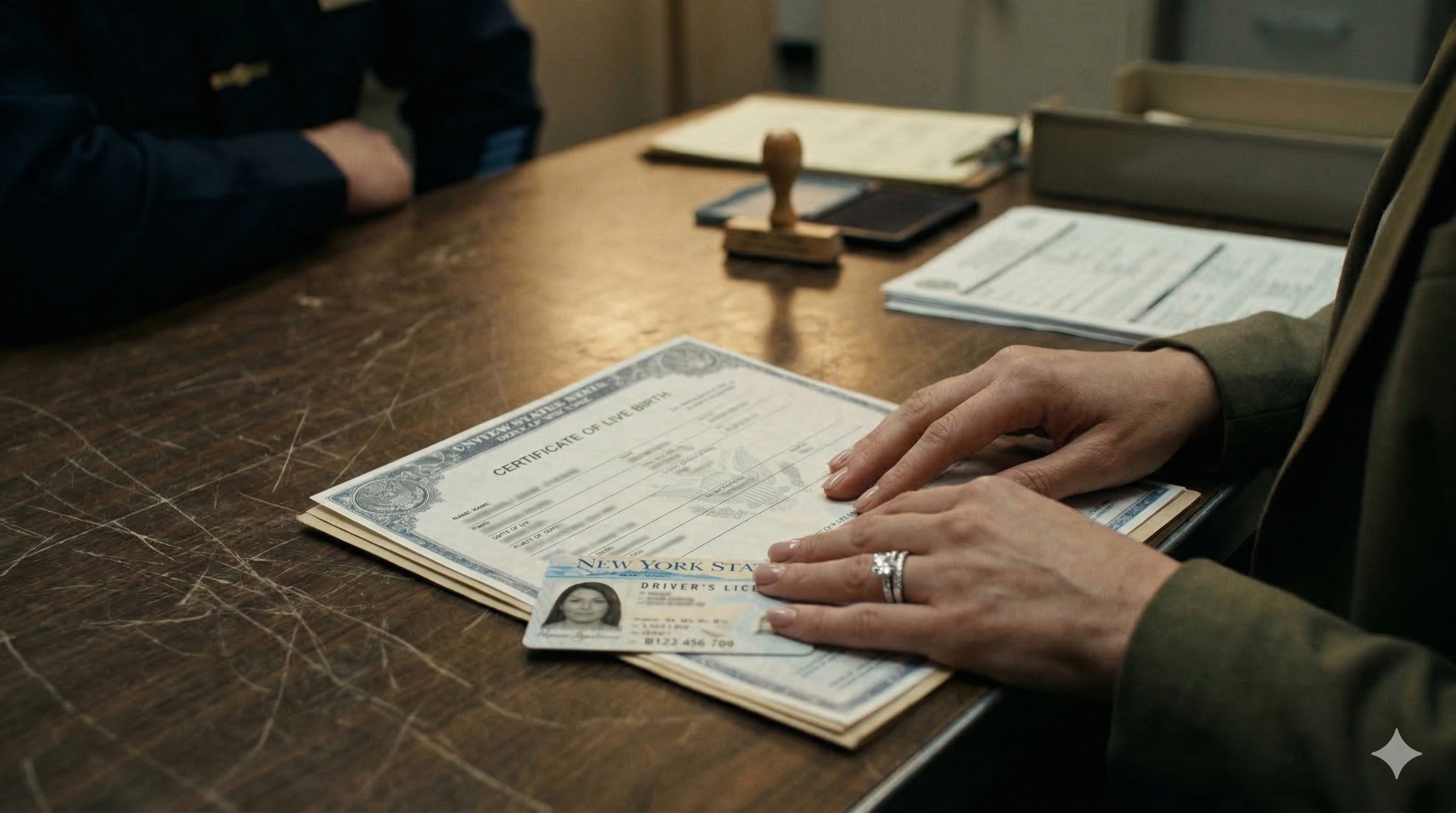
You are a woman who married twenty years ago and changed your name. Your birth certificate says one name. Your driver’s license says another. You have come to register to vote, documents in hand, having done what you were told to do.
The election official looks at them. There is a pause — not hostile, just procedural — while he decides whether what you’ve brought is sufficient.
You have rehearsed your explanation. You do not know whether this particular official, in this particular county, will accept it. The outcome depends on his judgment — arbitrary in the sense that no clear standard governs his decision — not on your citizenship.
This is not hypothetical. New Hampshire implemented proof-of-citizenship requirements for local elections in 2024. Nearly a hundred voters were turned away at polling places.7
One woman had to return three times: first without her birth certificate, then with a birth certificate that didn’t match her married name, then finally with both a marriage license and birth certificate. Some of the voters turned away that day never came back.
The friction doesn’t have to deny. It only has to discourage. And discouragement — quiet, procedural, entirely non-malicious — is how this grammar has always done its most effective work.
Notice what you are doing in that pause. You are calibrating — reading his demeanor, adjusting your explanation, performing your legitimacy for an audience with unchecked authority over your participation in your own governance.
Pettit names this precisely: the employee who self-censors because they might be fired is unfree even if they are never fired. The domination is not in the outcome. It is in the calibration the arbitrary power requires.
That pause — that rehearsed explanation, that reading of a stranger’s face — is what Pettit means. It is what Ibsen meant. It is what DuVernay showed us. It is what the SAVE America Act is rebuilding, with updated paperwork, for the twenty-first century.
⁂
The friction is the point. It always has been.
Consider what the full repertoire sounds like.
Election Day on a Tuesday — not a holiday, a workday — one on which the managerial class adjusts its calendar and the hourly worker asks permission from an employer who may or may not grant it.
Polling places concentrated in the neighborhoods where the people who design election infrastructure tend to live, sparse where they don’t.
Lines of forty-five minutes in the suburbs and four hours in the precincts where the working poor cast their ballots.
Poll locations that change without notice. Hours that shrink. Early voting windows that appear and disappear. Absentee rules that tighten between elections.
Each adjustment individually defensible. Each one landing, with a consistency that should trouble any honest observer, on the same populations.
And now: document requirements that add hours of bureaucratic effort for the Americans who have never had the luxury of assuming their paperwork was in order — the same Americans whose births went unregistered in counties that didn’t particularly welcome them, whose names changed after marriages the system now demands they re-document, whose naturalization certificates are being flagged as insufficient by a database that was wrong about them in Texas last year and will be wrong about them again.
None of these arrangements says “you cannot vote.” Each one says: voting will cost you more than it costs your neighbor. And they are not random in who bears that cost.
I’ve traced the genealogy of this grammar across recent essays in this series — through four ages of American formation — and shown how each generation’s instruments became invisible by becoming infrastructural.
The SAVE America Act belongs to that genealogy. I will not rehearse the full evidence here. But the pattern has a signature: neutral language, disparate impact, consistent directionality. When the same populations bear the cost of every “individually defensible” adjustment across two centuries, the word coincidence stops being adequate.
The instruments change with each age. The grammar underneath them does not. The SAVE America Act is what that grammar looks like when it has updated its paperwork for the twenty-first century.8
⁂
We've covered a fair amount of ground — from Pettit's philosophy to Ibsen's marriage to a county desk in New Hampshire. The question underneath all of it is simpler than the vocabulary: When a law demonstrably prevents far more citizens from voting than noncitizens, what does faithfulness require of the people who benefit from the architecture? You don't need to have tracked every detail to follow what comes next.
For this is precisely what Jesus-followers are called to renounce when we pledge to love our neighbors as ourselves. Not merely to refrain from cruelty. To relinquish the architecture.
When a lawyer asked Jesus to define “neighbor,” Jesus didn’t answer with a principle. He answered with a body — a specific man, beaten, lying in a ditch.
But notice what the parable actually does: it doesn’t expand the definition of neighbor. It exposes the lawyer’s formation. The priest and the Levite did not pass by because they were cruel. They passed by because they had organized their lives — their ritual obligations, their purity practices, their sense of what counted as their business — so that this particular body did not register as a claim on them.
The parable’s judgment falls not on malice but on the practiced, reasonable, entirely sincere capacity not to see.
That is the indictment the rich man in Luke 16 also faces. He did not kick Lazarus. He feasted. Daily. Reasonably. The gate was not a weapon. It was an arrangement — one that required, each morning, a choice not to look.
This is not merely an ethical failure — it is a distortion of the social order as God constituted it in Christ, who took flesh under an empire that also had document requirements for its subjects.
The incarnation does not declare that political participation is the source of human dignity — that dignity is prior, grounded in the image of God, and no bureaucratic apparatus can confer or revoke it. But precisely because that dignity is prior, no political mechanism may arbitrarily obstruct a person’s access to the common life of their community.
The barrier is the offense — not because participation completes the person, but because unnecessary exclusion distorts the community.
⁂
The question is not whether citizenship can be verified. It is whether verification should vest discretionary power in the hands of officials formed by this particular history, in these particular communities.
The SAVE America Act does not accidentally place that power in local officials. It deliberately puts it there — in the counties, in the precincts, in the communities where the history of who gets to participate has never been neutral.
The official who will administer this bill is not an abstraction. He is a formed person, living inside a grammar that arrived before he did, carrying it in his bones the way we all carry our formations — experiencing the arrangement as natural, as appropriate, as simply the way things are. That formation was in him before the power arrived in his hands.
The bill provides the architecture the grammar has always been waiting for.
This is not speculation about bad actors. The DHS database this bill requires states to use has already incorrectly flagged naturalized citizens for removal in Texas — disproportionately in the same communities where discriminatory gatekeeping has always concentrated.9 The domination is not a future risk. It is a present and documented pattern being handed a new set of administrative instruments.
Whether any individual official consciously abuses that power is beside the point. The mere existence of arbitrary gatekeeping power in the hands of officials formed by two centuries of this grammar — in the communities shaped by two centuries of this grammar — is itself the domination.
The church that has watched this pattern repeat across those two centuries has no excuse for calling it anything else.
⁂
Now I need you to notice something about yourself — and I ask it alongside rather than from above, because I have had to notice it about myself first.
I grew up in Baton Rouge formed by a world whose arrangements felt, from inside them, entirely natural. I did not experience the redlining maps as redlining maps. I experienced them as neighborhoods.
I did not experience the document requirements of my formation as requirements at all — I experienced them as simply the way things are, which is what successful formation always feels like from the inside.
It took someone who loved me enough to ask hard questions about my actual practices — not my stated beliefs, my practices — before I began to see the architecture I had inherited as architecture rather than air.
Formation is not fate. But it is powerful enough that most of us cannot see it without help — which is why the Christian tradition calls the moment of seeing not achievement but grace.
If you have never once worried whether your documents were in order to exercise a right — if citizenship has always felt like the water you swim in rather than a credential you must produce on demand — then you experience non-interference as freedom because for you, almost always, it is. The sword isn’t pointed at you. It hasn’t been pointed at you or your children or their children for as long as anyone can remember.
That is not an accident. It is an inheritance.
The communities who today lack ready access to these documents are the same communities whose births went unregistered, whose mortgages were denied, whose literacy was legally suppressed. The architecture changed. The distribution of its burdens did not.
The document gap was not random. The United States did not achieve universal birth registration until the 1940s — and even then unevenly. Black births in the Jim Crow South went systematically unregistered: one study estimated that one-fifth of African Americans born in 1939 and 1940 were never issued birth certificates. The same records offices that declined to register those births are the institutions whose documentation this bill now requires as proof of citizenship. The architecture changed. The gap it built did not close. The documentary requirements simply found it.10
And inheritances carry their own accountabilities — not the accountability of guilt for what was done before you arrived, but the accountability of sight: to see what the inheritance built, and to refuse to call it reasonable when it is not.
⁂
And if you are reading this essay and finding yourself persuaded — if you already opposed this bill before you got here — I want to press one more question. Not about your politics. About your formation.
Have you organized your life so that the people most burdened by this bill are not your neighbors in any concrete sense? Do you live in a neighborhood where document access has never been in question — where citizenship feels like water, not credential? Have you inherited what was built without being required to see what it cost the people it excluded?
I am not asking whether you believe the right things. I am asking what the Contrapuncti asked: what does your body do? When the friction falls on someone else — when it has always fallen on someone else — it is invisible.
And its invisibility is not an accident of perception. It is an achievement of formation. The arrangements made sure of it.
The question is not whether you will oppose the bill. It is whether you will feel Lazarus at the gate as a claim on your actual life — your neighborhood, your church, your school, your professional network — rather than as a political position you already hold.
I don’t have a program for you. Programs are trophy cases waiting to happen. But I can tell you what the question sounds like when it gets concrete: Which of your institutions — your congregation, your neighborhood association, your professional network — would be disrupted if the people most burdened by this bill were actually present in them? That disruption is where repentance begins to have content.
⁂
The SAVE America Act is not asking you to be cruel. It is asking you to be comfortable. It is asking you to look at a bill whose burden falls on people whose documents you have never had to think about — disproportionately the poor, people of color, married women, tribal members, naturalized citizens who crossed oceans and wept when they took the oath — and call it reasonable election integrity.
There is one more irony, and it has the quality of a parable. The states with the weakest vital records infrastructure — the highest rates of unregistered births, the lowest passport ownership, the most rural populations with the longest drives to document offices — are overwhelmingly the states whose representatives voted for this bill.
The communities most likely to lack qualifying documentation live disproportionately in red states. The bill’s sponsors are building a gate their own constituents are least equipped to walk through. The grammar is so thorough in its work that they are constructing the architecture of their own people’s disenfranchisement — and experiencing it as protection.
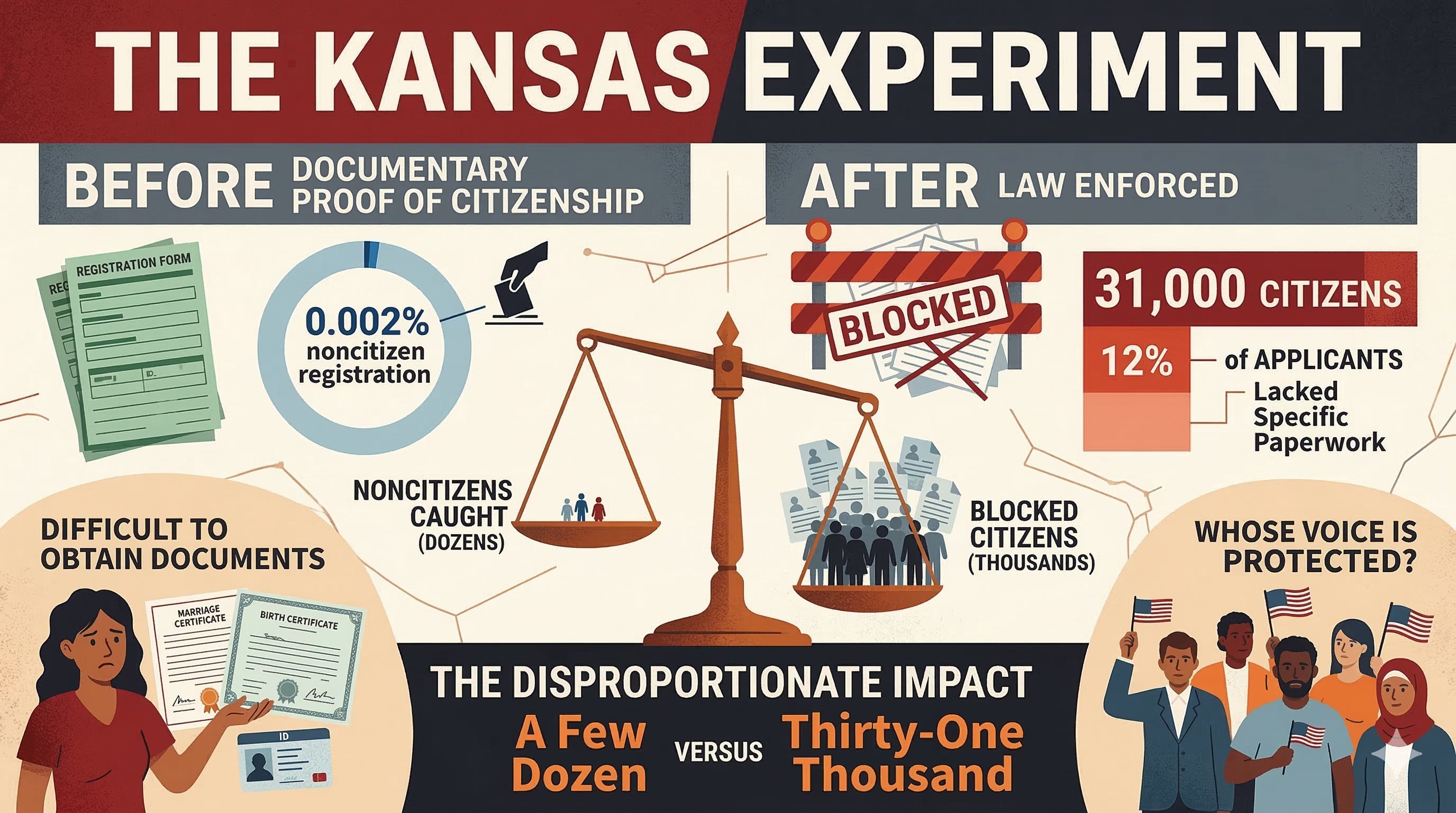
And the evidence that repudiates the bill’s premise comes not from its opponents but from its own. Kansas already ran this experiment. From 2013 to 2018, under a Republican secretary of state who made documentary proof-of-citizenship his signature cause, the requirement blocked 31,000 eligible citizens — 12% of all applicants — while catching 39 noncitizen registrations over nineteen years.
That is a ratio of roughly 795 citizens blocked per noncitizen caught. The noncitizen registration rate before the law was 0.002% of registered voters.
Georgia audited 8.2 million voters and found 9 noncitizen ballots. Utah reviewed its entire voter roll — over 2 million — and found one confirmed noncitizen registration and zero noncitizen votes. Every court that reviewed the Kansas law reached the same conclusion. The Supreme Court declined to hear the appeal. The experiment is over. The results are in the record.11
The architecture is real. The threat it addresses is not.
⁂
Mathew Carey made his judgment in 1820. He was a reasonable man. The registrars of Dallas County made theirs in 1965. They were reasonable men too.
We know what they built.
The standard moved whenever Annie Lee Cooper answered correctly. The SAVE America Act places someone local in every county with the power to move it again.
The question the neighbor commandment puts to us is not whether we will be cruel. It is whether we will relinquish the architecture — quietly, procedurally, reasonably erected — that makes cruelty unnecessary because the domination is already accomplished before anyone has to raise their voice.
That relinquishment has a name. We call it repentance. And it begins, always, with seeing.
(Hero image generated with Google Gemini and composed in Substack's design tools.)
Notes
Andrew Shankman, “Capitalism, Slavery, and the New Epoch: Mathew Carey’s 1820,” in Sven Beckert and Seth Rockman, eds., Slavery’s Capitalism: A New History of American Economic Development (Philadelphia: University of Pennsylvania Press, 2016), 256. Shankman’s assessment of Carey as “at his best when also at his worst” is at 259–260. I trace the grammar conversion Carey performs — and its genealogy through four subsequent ages of American formation — in

Philip Pettit, Just Freedom: A Moral Compass for a Complex World (New York: W. W. Norton, 2014). Pettit introduces the Ibsen example at Location 619 (Kindle edition): “The character of Nora in Ibsen’s A Doll’s House offers a vivid example of someone who enjoys freedom as noninterference — indeed, freedom as noninterference across a relatively wide range of choice — but who lacks freedom as non-domination.” The “doorkeeper” analysis — that Torvald monitors Nora’s choices such that she acts not on her own will but at his sufferance — is developed at Locations 810–827. Pettit’s broader republican framework, tracing freedom as non-domination from Roman political thought through the Italian-Atlantic republican tradition to the American founding, occupies the first four chapters. The “eyeball test” — that people should be “so resourced and protected in the basic choices of life that they can look others in the eye without reason for fear or deference” — is at Location 224.
National Voter Registration Act of 1993, 52 U.S.C. §§ 20501–20511. Section 20507(b)(2) establishes the self-attestation model: applicants attest to citizenship under penalty of perjury. False attestation is a federal crime under 52 U.S.C. § 20511(2), carrying penalties of up to five years imprisonment and $10,000 in fines. The SAVE Act (H.R. 22, 119th Cong.) would replace self-attestation with documentary proof for all new registration applications filed after enactment.
The 3.8 million figure is from Brennan Center for Justice, VoteRiders, and the University of Maryland, "Survey on Voter ID and Documentary Proof of Citizenship" (2024), which found that 21.3 million voting-age citizens (9.1%) lack ready access to a passport, birth certificate, or naturalization papers, and at least 3.8 million lack these documents entirely — lost, destroyed, stolen, or never issued. The Bipartisan Policy Center's March 2026 analysis, using MIT's Survey of the Performance of American Elections, found approximately 12% of registered voters lack documentation qualifying under the SAVE Act — a higher figure because BPC applied the bill's specific requirement that a birth certificate be paired with a photo ID. Document costs: U.S. Department of State, "Passport Fees" (current schedule, no fee waiver provision exists); USCIS Form N-565 (naturalization certificate replacement), $505–$555; USCIS Form N-600 (Certificate of Citizenship), $1,385.
The 24th Amendment prohibits conditioning the right to vote in federal elections on "failure to pay any poll tax or other tax." The Safeguard American Voter Eligibility (SAVE) Act, H.R. 22, 119th Cong. (2025), passed the House 218–213 on February 11, 2026. The bill imposes no explicit fee — it requires documents. But for the 3.8 million citizens who lack any qualifying documentation (see note 10), the path to a qualifying document is necessarily a fee-bearing one: $165 for a passport (U.S. Department of State fee schedule, current as of March 2026; no waiver exists under any circumstances), $505 to $555 for a replacement naturalization certificate (USCIS Form N-565), $1,385 for a Certificate of Citizenship (USCIS Form N-600). The bill provides no document assistance program, no fee waiver mechanism, and no federal subsidy for the documents it requires. Congresswoman Jennifer McClellan (D-VA) made the comparison during House floor debate on February 11, 2026. Whether a mandatory documentary requirement that can only be satisfied by paying unavoidable fees to a federal agency constitutes a de facto poll tax under the 24th Amendment is a question several voting rights organizations have flagged as potentially dispositive. No court has been asked to decide it. The Amendment says the same thing in fewer words.
White House Press Secretary Karoline Leavitt offered this reassurance during a press briefing in March 2026. The Campaign Legal Center's section-by-section analysis of the SAVE Act (Campaign Legal Center, "The SAVE Act: What You Need to Know," 2026) confirms that any registration update — address change, name change, party switch — triggers the full documentary proof requirement, since updates are legally treated as new "applications to register to vote" under the National Voter Registration Act (52 U.S.C. § 20507). The 30 million figure is from Election Assistance Commission registration transaction data for federal election cycles. The 9% annual mobility rate is from the U.S. Census Bureau, Current Population Survey, Geographic Mobility tables. The bill's Section 4 mandates submission of entire state voter rolls to the DHS SAVE database within 30 days of enactment, with removal for anyone flagged — a provision that reaches all 211 million registered voters simultaneously. The reassurance that the already-registered are unaffected is accurate for the subset of the electorate whose circumstances never change. That subset is smaller than the reassurance assumes, and it is not randomly distributed.
New Hampshire’s SB 418, enacted in 2024, requires documentary proof of citizenship for voter registration in local elections. The nearly 100 voters turned away and the woman who returned three times were reported by the New Hampshire Secretary of State’s office and confirmed by New Hampshire Public Radio and the Concord Monitor in their coverage of the 2024 municipal elections.
In recent essays published as Contrapunctus I through V of Essay 11 of this series, I traced the instruments through which dominative grammar inscribed itself into American common life across four Ages: Commerce, Capital, Control, and Chaos. The pattern was consistent: each generation's instruments became invisible by becoming infrastructural — built into zoning maps, mortgage tables, highway routing decisions, school district boundaries. None required racial language. Each produced racially specific outcomes with actuarial precision. The SAVE America Act belongs to this genealogy. It is not the whip. It is not the redlining map. It is not even the literacy test — it doesn't require the same hands-on administration, the same direct confrontation between registrar and applicant. It is more sophisticated: it outsources the exclusionary work to a federal database and a county official with discretionary authority, maintaining the appearance of uniform standards while the database's error rates and the official's unguided judgment do the work the grammar has always done. In the taxonomy I traced across those essays, this is the Age of Chaos instrument: decontained, privatized, deniable. The profane sacrament has updated its liturgy. The formation it accomplishes is identical.
The bill’s reliance on the DHS Systematic Alien Verification for Entitlements (SAVE) database warrants extended attention. The database was designed to verify immigration status for government benefit programs — a purpose for which moderate error rates carry administrative inconvenience. Applied to voter roll verification, the same error rates carry constitutional consequence: flagged voters face removal from rolls they have maintained for years, with a notice period shorter than the five-to-eight-month processing time for naturalization certificate replacement. The documented error rates: Boone County, Missouri — more than half the flagged voters were U.S. citizens (Boone County Clerk’s Office, reported in the Columbia Missourian); Alabama — 94% of voters removed through DHS data were citizens, and the purge was halted by court order (United States v. Alabama, No. 2:11-cv-02746 (N.D. Ala.)); North Carolina — approximately 98% of those flagged were citizens (North Carolina State Board of Elections review, 2014); Iowa — initial flags of 2,176 potential noncitizens resolved, after investigation, to 35 confirmed noncitizen voters out of 1.6 million ballots (Iowa Secretary of State’s office, 2012). The pattern is consistent across states, partisan configurations, and investigative methodologies: the database overcounts by factors of ten to one hundred. The overcounting receives the headlines. The corrections receive the silence. The bill makes this database the mandatory, ongoing mechanism for verifying the citizenship of all 211 million registered voters.
The one-fifth figure is from the Brennan Center for Justice, “Citizens Without Proof: A Survey of Americans’ Possession of Documentary Proof of Citizenship and Photo Identification” (2006). On delayed birth registration generally, see Sam Shapiro and Joseph Schachter, “Birth Registration Completeness, United States, 1950,” Public Health Reports 67, no. 6 (1952): 513–524, which documents that universal birth registration was not achieved until the late 1940s; as late as 1942, approximately 200,000 births per year went unrecorded. For citizens whose births were never formally registered, the path to qualifying documentation is genuinely labyrinthine. Obtaining a delayed birth certificate requires a “Letter of No Record” from the vital records office of the state of birth. The applicant must then gather early public or private records from the first five years of life: baptism certificates, hospital records, census records, early school records, family Bible entries, doctor’s records of post-natal care. If those records no longer exist — and for rural Black families in the pre-civil rights South, many do not — Form DS-10 allows notarized affidavits from older blood relatives with direct knowledge of the birth. For elderly citizens, those relatives are frequently deceased. South Carolina’s vital records office acknowledges the process “can be long” and that sometimes “the only option is for someone to present what they have to a judge.” The process can take months, cost hundreds of dollars, and offer no guaranteed outcome. The bill does not question anyone’s sincerity. It questions their paperwork. These are not the same question, and the grammar that produced the gap between them — the same grammar that ensured certain births went unregistered by the same government that now requires proof of that registration — has not been interrupted. It has merely acquired new instruments.
The Georgia figure is from the Georgia Secretary of State's office, which completed a post-election audit of 8.2 million voter records in 2022 and identified 9 noncitizen ballots. The Kansas figures are not my numbers. They are Kansas's numbers, established under oath. In Fish v. Schwab, 957 F.3d 1105 (10th Cir. 2020), Kansas officials conceded in litigation that over 99% of the 31,000+ people blocked by their documentary proof-of-citizenship law were U.S. citizens. The 12% figure — one in eight applicants — is from the same proceedings and confirmed by the Associated Press, the Bipartisan Policy Center, and the Institute for Responsive Government. The 0.002% pre-law noncitizen registration rate comes from the Bipartisan Policy Center's analysis. Kansas appealed all the way to the Supreme Court. SCOTUS declined to hear the case in December 2020, leaving the Tenth Circuit's ruling intact. The law hasn't been enforced since 2018. Every court that reviewed it — district, circuit, and implicitly the Supreme Court — reached the same conclusion. The accumulation of state-level investigations elsewhere has produced the same verdict. Michigan: 15 confirmed noncitizen voters out of 5.7 million ballots. Iowa: 35 confirmed noncitizen voters out of 1.6 million, after initial flags of 2,176 resolved on investigation. Utah: entire voter roll reviewed over nine months — one confirmed noncitizen registration, zero noncitizen votes. Wyoming's Laramie County: 13 voters flagged — after ICE investigation, all 13 legally eligible. Eighteen states have conducted reviews and publicly reported finding no noncitizen voters whatsoever. The Heritage Foundation's own database of "proven instances of voter fraud" — 1,546 cases assembled over decades — contains 68 total cases of noncitizen voting across forty years. Only ten involved undocumented immigrants. When the prosecution's star witness confirms the defense's case, one notes it.