

The Only Manna We Keep: A Christmas Reflection on Keeping By Releasing
Jazz, Shame, and Being With — Essay #8


Dear friends—
Here’s the short version: the only manna that didn’t rot was the manna released to God—everything hoarded bred worms. This essay traces what that ancient distinction might mean for the Christianity I inherited.
I went looking for this because the modern genealogy I’ve been tracing couldn’t explain why the faith that sings Mary’s reversals so readily blesses extraction economy. The deeper grammar lives here—in the wilderness catechism where Israel learned to receive without hoarding, and in the Emmaus table where recognition came not through teaching but through bread broken and shared.
If you’ve ever felt your body tighten around money even when you have enough, or wondered why Christmas feels spiritually thin, this may help name what’s underneath. The vocabulary moves between Luke’s gospel, Hebrew scripture, neuroscience, and political economy. You don’t need to track every term. What matters is whether this names something your body already knows.
The Jar in the Ark
There’s a detail in the Exodus story I’d overlooked for forty years.
You remember the manna—bread from heaven, Israel’s daily provision in the wilderness. You probably remember the rules: gather only what you need for today; don’t store it up; trust that tomorrow’s bread will come tomorrow. And you might remember what happened when people ignored those instructions and hoarded extra against the uncertain future. It rotted. Bred worms. Stank.
Except once.
Moses told Aaron to take an omer of manna and place it before the Lord, “to be kept throughout your generations.”1 This single jar of manna traveled with Israel through forty years of wandering, eventually resting in the Ark of the Covenant alongside the tablets of the Law and Aaron’s rod that budded.2 Three objects. The tablets—the Word, God’s instruction for covenant life. The rod—Aaron’s staff that bloomed with almonds, authority that flowers rather than dominates. And the manna—provision that comes daily, cannot be hoarded, must be received. The same manna that rotted when families stored it in their tents was preserved for centuries when kept in the presence of the Word.
The tradition calls it “bread from heaven.”3 That phrase echoes through Israel’s memory, reappearing whenever the community remembers wilderness provision. By the time we reach John’s Gospel, Jesus will claim to be the true bread from heaven, the manna that doesn’t run out. The connection I’m tracing between manna and Incarnation isn’t my invention. It’s a trajectory already present in Israel’s own re-reading of the story.
I’ve been sitting with this detail through Advent, wondering what it might mean that the only manna permitted to be retained—rather than circulated—was the manna that dwelt with the Word as witness.

I wasn’t looking for this. I’d been tracing a genealogy of Christianized Stoicism—the formation I promised in Essay 7 to investigate, running from ancient philosophy through medieval atonement theology to modern nationalism. Months of work on Lipsius, Locke, Kant, Schmitt. But none of it explained why my inherited Christianity so readily blesses extraction economy, why the faith that sings Mary’s reversals makes peace with store-cities full of rotting manna.
The modern genealogy showed how we arrived here. It didn’t show the deeper grammar—the ancient choice between two economies that every generation faces again.
So I went back. Before Stoicism. Before the mutations I’ve been tracing. Back to the wilderness catechism where a people newly escaped from Pharaoh learned to receive differently.
Mary knew something about manna.
A young woman, probably thirteen or fourteen, unmarried, from a village so insignificant it warranted Nathanael’s famous sneer: “Can anything good come out of Nazareth?”4 Luke tells us she was “much perplexed” by the angel’s greeting—and why wouldn’t she be? She was being invited into the kind of divine disruption that ruins careful plans.
But then Mary sang. And what she sang wasn’t a lullaby.
“He has scattered the proud in the imagination of their hearts. He has brought down the powerful from their thrones, and lifted up the lowly. He has filled the hungry with good things, and sent the rich away empty.”5
Biblical scholars call this the “prophetic perfect tense”—speaking of future reversals as if they’ve already happened.6 Not wishful hoping but confident declaration. The way our civil rights movements sing “We Shall Overcome” while Pharaoh’s economy still rules. The reversal isn’t complete, but its completion is so certain that you can sing about it in past tense.
Mary’s song announces that God is doing something. And what God is doing has economic teeth. The hungry filled, the rich sent empty, the proud scattered, the powerful unseated. This isn’t spiritualized comfort for the oppressed while leaving oppression intact. This is reversal, not reform.
The first time Luke mentions “the rich” is in Mary’s song—and it’s not flattering.7 Whatever is about to happen in the manger will have something to say about wealth, poverty, and who gets to keep what.
We have, of course, found ways to neutralize this. The Magnificat is among the most frequently performed pieces in the Western choral repertoire—gorgeously orchestrated, sung by choirs in evening dress to audiences in evening dress, the revolutionary lyrics wrapped in such aesthetic splendor that we can appreciate the music without hearing the words. Mary announces the unseating of the powerful, and we applaud the soprano’s high notes. She proclaims the hungry filled and the rich sent empty, and we check our programs for the next movement.
This is the church’s particular genius: we can sing what we refuse to practice, perform what we decline to embody, make beautiful what we will not let be true. The Magnificat becomes a concert piece rather than a confession—something to be admired rather than obeyed. And so Mary’s song, which should land in our gut as summons and disruption, floats harmlessly over our heads as lovely sound.
The prophets had a word for worship that doesn’t change anything. They called it noise.
Here’s where Christmas gets strange.
We Western Christians have mostly learned to hear the Incarnation as God’s solution to our sin problem. Humanity fell; we couldn’t fix ourselves; God sent Jesus to pay the debt, absorb the punishment, satisfy the requirement. Christmas becomes the delivery date for our salvation package—God arriving to work for us, to accomplish on our behalf what we couldn’t accomplish ourselves.
But reading Luke again this Advent, I’m noticing something different.
Luke’s Jesus, when he finally begins his ministry, quotes Isaiah in his hometown synagogue: “The Spirit of the Lord is upon me, because he has anointed me to bring good news to the poor. He has sent me to proclaim release to the captives and recovery of sight to the blind, to let the oppressed go free, to proclaim the year of the Lord’s favor.”8
The “year of the Lord’s favor” is Jubilee—the great redistribution, when debts are cancelled, slaves freed, and land returned to families who’d lost it.9 Jesus announces his ministry as the inauguration of Sabbath economics. Not just individual salvation but systemic restoration. Not just forgiveness of personal sin but release from the structures that bind and impoverish.
What if the Incarnation isn’t primarily about God fixing our problem from outside, but about God being with us inside the problem?10
What if the baby in the manger—laid in a feeding trough because there was no space in the guestroom, born to displaced parents pushed by empire’s census, visited first by shepherds working the night shift—what if this is God demonstrating not how to escape our condition but how to inhabit it differently?
What if Christmas is less about God providing a solution and more about God becoming present—the Word made flesh, dwelling among us, full of grace and truth?11
The manna that rotted when hoarded didn’t rot when kept with the Word.
I think Luke wants us to see the connection.
The Road to Emmaus
Luke does something unusual with his Gospel. He ends where he begins.
The final chapter finds two disciples walking the seven miles from Jerusalem to Emmaus, devastated. Jesus is dead. Whatever they’d hoped would happen hadn’t happened. “We had hoped that he was the one to redeem Israel,” they tell the stranger who falls into step beside them.12 Past tense. Hope extinguished.
The stranger asks what things have happened. They’re astonished—is he the only visitor to Jerusalem who doesn’t know? They recount it all: Jesus of Nazareth, a prophet mighty in deed and word, handed over by chief priests and leaders, condemned to death, crucified. Three days now. Some women found the tomb empty, saw a vision of angels, said he was alive. But him they did not see.
Then the stranger speaks. “Oh, how foolish you are, and how slow of heart to believe all that the prophets have declared! Was it not necessary that the Messiah should suffer these things and then enter into his glory?”13
And beginning with Moses and all the prophets, he interpreted to them the things about himself in all the scriptures.
I want to stay here for a moment, because this is the church’s first Bible study.14
Before there were creeds or catechisms, before councils defined orthodoxy, before systematic theologies organized the faith into categories—there was this: the risen Jesus walking with confused disciples, opening the scriptures, showing them how to read Moses and the prophets in light of what had just happened.
What did he teach them?
Luke doesn’t give us the transcript. But Luke has already shown us, through the entire Gospel, what it means to read scripture through Jesus’s eyes. And what it means is Sabbath economics.
Go back to the wilderness.
After the exodus from Egypt, Israel wandered forty years in desert country. No agriculture possible. No economy to speak of. Just daily dependence on God’s provision—manna in the morning, quail in the evening, water from rock.

Ched Myers calls this period Israel’s “first catechism”—the basic instruction that formed a people.15 And the catechism had three lessons:
First: Gather only what you need. “Those who gathered much had nothing over, and those who gathered little had no shortage.”16 In the wilderness economy, there is such a thing as enough. Not everyone scrambling to maximize, not winners and losers, but sufficiency for all.
Second: Do not store it up. The manna that was hoarded rotted. Accumulation bred worms. The instinct to secure tomorrow by stockpiling today—the instinct Pharaoh’s economy had drilled into them through generations of slavery—that instinct had to be unlearned.17
Third: Rest. On the sixth day, gather enough for two days, because the seventh day is Sabbath. No manna will fall. No gathering required. Creation itself pauses. And in that pause, Israel would learn that the world does not depend on their anxious productivity. God provides. They can rest in fellowship.18
Here’s what I’d missed for decades: this Sabbath instruction comes before Sinai.19 Israel learns to receive before Israel learns to obey. The sequence matters. Exodus 16 precedes Exodus 20. Rest and provision aren’t rewards for keeping commandments; they’re the foundation that makes faithful living possible. You can’t practice Torah from a dysregulated nervous system. You have to learn you’re held before you can learn to hold others.
Sabbath isn’t a name for Sunday. It’s the name for an economy we’ve spent two thousand years avoiding.20
I grew up thinking Sabbath meant “the day Christians go to church”—a weekly obligation, a religious duty, the day you wore uncomfortable clothes and sat still. But that’s not what the tradition means.
It begins with creation. God worked six days and rested on the seventh—not because God was tired but because creation was complete. The world didn’t need more. It was good, very good, and the appropriate response to goodness is enjoyment, not improvement.21 Sabbath rest isn’t recovery time so you can be more productive tomorrow. Sabbath rest is our declaration that creation is enough.
From this weekly rhythm, the tradition elaborates. Every seventh year, the land itself rests—no planting, no harvesting, living on what grows wild.22 And every fiftieth year, the great Jubilee: all debts cancelled, all slaves freed, all land returned to ancestral families.23 The economic accumulation of forty-nine years—the inevitable drift toward concentration, where some families lose everything and others acquire everything—that drift gets reset. Jubilee is the economy’s Sabbath, the declaration that the current distribution isn’t final, that God’s vision of enough-for-everyone keeps interrupting the human tendency toward hoarding.
This is what Jesus announced in Nazareth. “The year of the Lord’s favor.” Jubilee. Not spiritual metaphor but economic reality. Good news to the poor. Release to the captives. The oppressed going free.24
Jesus would relive this formation in miniature. Luke tells us that after his baptism, Jesus was led by the Spirit into the wilderness for forty days, tested as Israel was tested.25 Where Israel grumbled for bread, Jesus refused to turn stones into provision. Where Israel doubted God’s presence, Jesus refused to test the Father. Where Israel flirted with other gods, Jesus refused empire’s offer of all the kingdoms. The one who would teach manna economics had first to embody it—learning in his own body what it means to receive daily bread rather than secure tomorrow’s supply.
Israel’s forty years of wilderness catechism finds its fulfillment in Jesus’s forty days. What Israel learned partially and forgot repeatedly, Jesus lives completely. The teacher of Sabbath economics is also its first graduate.
Now watch what happens on the Emmaus road.
The disciples don’t recognize Jesus while he’s teaching. Their hearts burn within them—something is happening—but their eyes are kept from recognizing him.26 The revelation comes later.
They reach Emmaus. The stranger walks ahead as if going farther. They urge him to stay: “It is almost evening and the day is now nearly over.”27 He agrees. They sit down to eat.
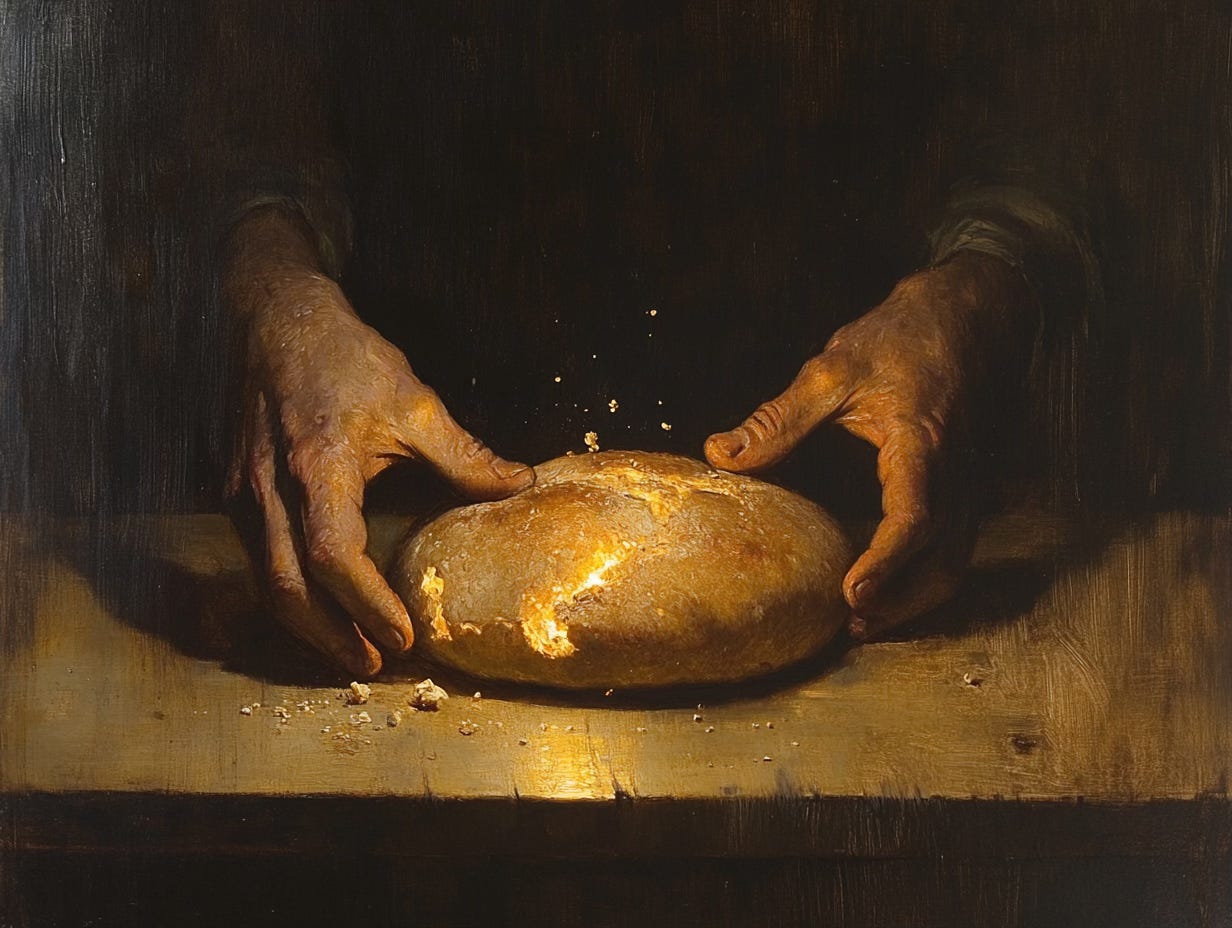
“When he was at the table with them, he took bread, blessed and broke it, and gave it to them. Then their eyes were opened, and they recognized him.”28
The recognition happens at table.
Not during the Bible study—though their hearts burned during that. Not through theological argument or scriptural proof. At the moment when bread is taken, blessed, broken, and given.
This is manna economics performed.
Bread taken—acknowledging the gift, receiving what has been provided. Bread blessed—giving thanks, recognizing that provision comes from beyond ourselves. Bread broken—not kept whole for private consumption but divided for sharing. Bread given—circulated to others, passed around the table, released rather than retained.
The disciples had walked seven miles with the risen Lord and hadn’t known him. But when he performed the economy of the kingdom—when gifts were received and released rather than hoarded—their eyes opened.29
I wonder if Luke is suggesting that we can study scripture all we want, can have our hearts burn with beautiful theology, can recite all the right doctrines about Jesus—and still not recognize him. Recognition happens when we practice what he practiced. When bread circulates rather than accumulates. When we trust tomorrow’s manna to come tomorrow rather than storing against imagined scarcity. When the Sabbath vision becomes the shape of our common life.
The risen Jesus is made known in the breaking of bread.30 Here’s the way I learned to say it: the church doesn’t have an economic practice; the church is an economic practice—or it isn’t the church.
The risen Jesus is made known in the breaking of bread. But here’s the hard truth beneath that claim: without a community that actually embodies release, the invitation I’m about to offer has nowhere to land.31 The question isn’t whether individual readers will stop hoarding. The question is whether there exists a community so formed by manna economics that people can be drawn into its practice—a community where daily bread is actually shared, where accumulation is actually discouraged, where your flourishing and my flourishing are so intertwined that hoarding becomes unthinkable.
If the church is just Pharaoh’s economy with better feelings—if we practice the same accumulation, defend the same borders, but add a spiritual gloss—then we’re not offering an alternative. We’re offering chaplaincy services for empire.
The Magnificat isn’t asking us to be more generous within an unchanged system. It’s announcing that the system is being replaced. “He has brought down the powerful from their thrones.” That’s not gentle invitation. That’s regime change.
We’ve covered a lot of ground—wilderness economics, first catechisms, bread broken at Emmaus. If you skimmed, or if the biblical references blurred together, that’s fine. Here’s what matters: two economies run through scripture. Pharaoh’s economy hoards against scarcity and breeds the anxiety that makes hoarding feel necessary. The manna economy receives daily bread and trusts tomorrow to bring tomorrow’s provision.
The question underneath all of this is simple: What if the Christianity we inherited has been teaching Pharaoh’s economics while singing Mary’s song? You don’t need to have tracked every thread to feel the weight of that question. I feel it in my chest when I write it. What follows is where this gets personal.
What We Refuse to Release
Here is where the newsletter gets uncomfortable.
I’ve been describing Sabbath economics as if it were ancient history—wilderness wandering, Jubilee legislation, first-century table fellowship. Interesting background for understanding Luke. Nice context for Christmas.
But the whole point of the Emmaus road is that Moses and the prophets aren’t background. They’re diagnosis. They name what’s wrong with the world and announce what God is doing about it. The risen Jesus didn’t offer his disciples a history lesson. He gave them eyes to see their present moment.
So let me try to see ours.
The manna rotted when Israel stored it against an uncertain future.
Think about what that means. The instinct to hoard—to accumulate more than you need today because tomorrow might not provide—that instinct comes from somewhere. It comes from the reasonable experience that the world is unpredictable, that provision isn’t guaranteed, that those who don’t secure their own future may find themselves without.
Pharaoh’s economy ran on this fear.32 Store-cities filled with grain extracted from peasant labor. Surpluses accumulated against famine. The few controlling what the many needed to survive. When you’ve been formed by that economy—when anxiety about scarcity is the water you swim in—then of course you hoard. Of course you store up. What else would you do?
Pharaoh’s genius wasn’t just economic extraction—it was nervous system formation.33 His store-cities didn’t merely hoard grain; they cultivated the chronic anxiety that makes hoarding feel necessary. When you keep people in perpetual precarity, their windows of tolerance narrow. They lose access to the neural circuitry of trust and connection. They become biological hoarders, unable to imagine that tomorrow’s bread might come.
Precarity. I’ve only recently learned this word, and it won’t let me go.34 It names something I’d sensed but couldn’t articulate: not poverty exactly, but the chronic condition of never being secure enough to stop performing, never stable enough to rest. The workforce that won’t demand better conditions because it can’t afford to risk what little it has.
The manna was God’s counter-formation. Daily bread. Enough for today. Tomorrow will have its own provision. The anxiety that Pharaoh cultivated—the fear that drove accumulation—that anxiety is a lie. Creation provides enough for everyone if everyone takes only what they need.
But we don’t believe it.
I don’t believe it.
I know where this comes from. I emerged from high school and Annapolis with a clear picture of what adult male achievement looked like: first serve your country—give your life if necessary—then accumulate honor for yourself and family through wealth and influence within your community. Be the gift. That was the catechism, and I internalized it completely. Even decades later, my limbic system still fires along those ancient grooves—implicit memory encoded in neural pathways before I had language to question it, procedural knowledge my prefrontal cortex can critique but cannot simply override.35
My wife and I have retirement accounts and emergency funds and insurance policies against every imaginable contingency. I tell myself this is prudent—and maybe it is. But I notice that my prudence never arrives at a number where I feel we have enough. The anxiety keeps recalibrating. The goalpost keeps moving. The scarcity Pharaoh taught is so deep in my bones that even manna from heaven might not convince me.36
And we are one of the lucky couples. We have enough that we can afford the luxury of worrying about having more. Plenty of people we know are genuinely precarious—one medical emergency, one job loss, one car repair away from disaster. Their anxiety isn’t neurosis; it’s accurate assessment of an economy that needs them anxious.
That’s the thing about scarcity. For some of us, it’s internalized psychology—Pharaoh’s voice in our heads long after we’ve left Egypt. But for others, it’s engineered reality—a system that produces precarity on purpose.37
Both are lies. But they’re different lies, and they require different responses.
The prophets saw this clearly.
When Israel settled in the land and established a monarchy, the old patterns reasserted themselves. Debt-default mechanisms transferred land from peasant families to wealthy creditors.38 The accumulation that manna economics prohibited became the economy’s engine. Some families lost everything across generations while others acquired everything.
The prophets were not subtle about this.
“The spoil of the poor is in your houses,” Isaiah thundered. “What do you mean by crushing my people, by grinding the face of the poor?”39 “Woe to those who join house to house, who add field to field, until there is no more room”—naming the debt-default mechanism by which the few acquire what the many lose.40 Amos condemned those who “trample on the needy and bring to ruin the poor of the land.”41 Jeremiah blamed the exile itself on Sabbath-breaking—not missing synagogue but refusing to release slaves, refusing to let the land rest, refusing to practice the economics of enough.42
This is what Mary’s song anticipates. God scattering the proud, bringing down the powerful, filling the hungry, sending the rich away empty. Not because God has arbitrary preferences about wealth distribution, but because the current distribution represents the abandonment of everything Israel was formed to embody.
The rich are sent empty because they’ve been hoarding manna. And it’s rotting in their store-cities while others go without.
The pattern didn’t start with the prophets’ generation. It started almost immediately.
When Solomon consolidated power, what did he build? Store-cities.43 The same infrastructure Pharaoh had forced Israel to construct in Egypt, Solomon now built for himself—with conscripted Israelite labor. The monarchy became Pharaoh’s economy under Israelite management. The temple that housed the Ark with its jar of manna stood alongside the store-cities that represented everything manna was meant to undo.
Israel didn’t just fail to practice Sabbath economics. Israel rebuilt Egypt and called it the kingdom of God.
I think about this when I see a president proclaim himself king, when I hear proposals for triumphal arches to rival Caesar’s monuments. The pattern is old. The instinct to return to Pharaoh—to trade wilderness vulnerability for imperial security, daily bread for store-cities, manna for monuments—that instinct runs deeper than any single nation or era. We keep rebuilding what we were delivered from, and blessing it in God’s name.
Now: America. Now: us.
We are the richest society in human history. Not approximately—precisely. No civilization has ever commanded the resources we command, produced the abundance we produce, accumulated the wealth we’ve accumulated.44
We have accomplished the miracle of scarcity amid abundance—not through plague or famine but through policy.
We have people sleeping under bridges. Families choosing between medication and groceries. Children going hungry in the wealthiest counties of the wealthiest nation that has ever existed.
This is not because we lack resources. It’s because we refuse to circulate them.
We have made political decisions—exposed as decisions by the fact that other wealthy nations have decided differently—to let healthcare be a commodity rather than a common provision.45 To let housing prices rise beyond reach while units sit empty as investments. To let food rot in warehouses while families line up at food banks. To let wages stagnate for decades while wealth concentrates beyond any precedent in human history.
The manna is rotting in our store-cities. We have more than enough for everyone. We simply refuse to release it.
But here’s what I’ve only recently begun to understand: the refusal to circulate isn’t just greed. It’s formation. The economy that shapes us doesn’t merely permit hoarding; it requires the fragmentation that makes hoarding feel necessary and solidarity feel impossible.
We’ve been taught to see ourselves as competitors rather than kin. The economy that shapes us insists that your gain threatens my security, that scarcity is real, that solidarity is naïve.46 We’ve been sorted into groups and taught that our group’s interests conflict with their group’s interests—that American workers compete with Mexican workers, that citizens’ needs conflict with immigrants’ needs, that my family can only flourish if some families don’t.
This sorting isn’t accidental. It serves a purpose.47
If workers across borders recognized their common interests, they might organize across borders. If citizens saw immigrants as fellow creatures rather than competitors, they might demand an economy that served everyone. If Western Christians understood that the Body of Christ includes believers in every nation—that our siblings in Guatemala and Somalia and Haiti are no less family than our neighbors—we might stop believing that borders mark the limits of our obligation.
The system that sorts us needs us to believe in the sorting.48 It needs us to identify with our group against other groups. It needs us to think that solidarity is impossible, that scarcity is real, that the best we can do is secure our own while hoping there’s something left for others.
This is the opposite of manna economics. And we’ve baptized it.
Dominative Christianity—the version I inherited, the version millions practice, the version that shapes our politics and forms our imagination—has largely made its peace with the refusal to circulate.49
We’ve found ways to spiritualize the Magnificat so it doesn’t threaten actual wealth distribution—which takes considerable interpretive creativity, given that Mary’s song is about as spiritually vague as a tax audit. We’ve performed the interpretive miracle of making Jubilee cost nothing—pretending it denotes spiritual release, inner freedom, personal salvation. We’ve reduced Christmas to a story about God solving our individual sin problem while leaving untouched the systems that grind the face of the poor.
Which is convenient, since interior problems don’t require anyone to redistribute anything.
And we’ve wrapped it all in the flag—performing the impressive theological feat of conscripting the God who refused borders into the service of border enforcement. Emmanuel—God with us—has been put on ICE. That line is too easy, which is part of what makes it unbearable.
The God who came to a colonized people under imperial occupation, was born to displaced refugees, and announced good news to the poor—this God has been conscripted into blessing our borders, baptizing our extraction economy, assuring us that our accumulation is providence and our refusal to share is prudence.50
The prophets had a word for this. They called it idolatry—serving gods who legitimate what the true God condemns.51
I would call it living the wrong story. Not the general, vague sinfulness we confess on Sunday mornings without meaning much by it—but the specific, concrete choice to inhabit Pharaoh’s narrative rather than God’s. The story where scarcity is real, solidarity is impossible, and siblings starve while store-cities overflow.
The Word Made Flesh
So what does Christmas offer?
I’ve just named Western Christianity’s captivity to an economy of accumulation—our complicity in systems that hoard while others hunger, our baptism of borders that fragment the human family, our refusal to circulate what we’ve received. If I stopped there, this would be a prophetic word without good news. Diagnosis without healing. That’s not the gospel. That’s just making everyone feel terrible and sending them home to feel terrible alone. I’ve preached that sermon. The congregation applauds, the guilt metabolizes into brunch, and nothing changes. Including me.
The prophets always paired judgment with invitation. “Return to me,” God pleads through Hosea, “and I will return to you.”52 The point of naming our false stories is never condemnation for its own sake. The point is to clear the ground for something else—something the false story has been blocking, something we couldn’t see while we were pretending everything was fine.
Christmas is that something else.
Go back to the manna one more time.
The jar in the Ark wasn’t stored for future consumption. It was kept as witness.53 A reminder across generations that God had provided, that the wilderness hadn’t killed them, that daily bread had come daily. The manna didn’t rot because it wasn’t hoarded—it was offered. Placed in the presence of the Word. Held in trust for the community’s memory rather than any family’s private security.
The manna that stayed sweet was the manna given back to God.
I think this is what the Incarnation looks like.
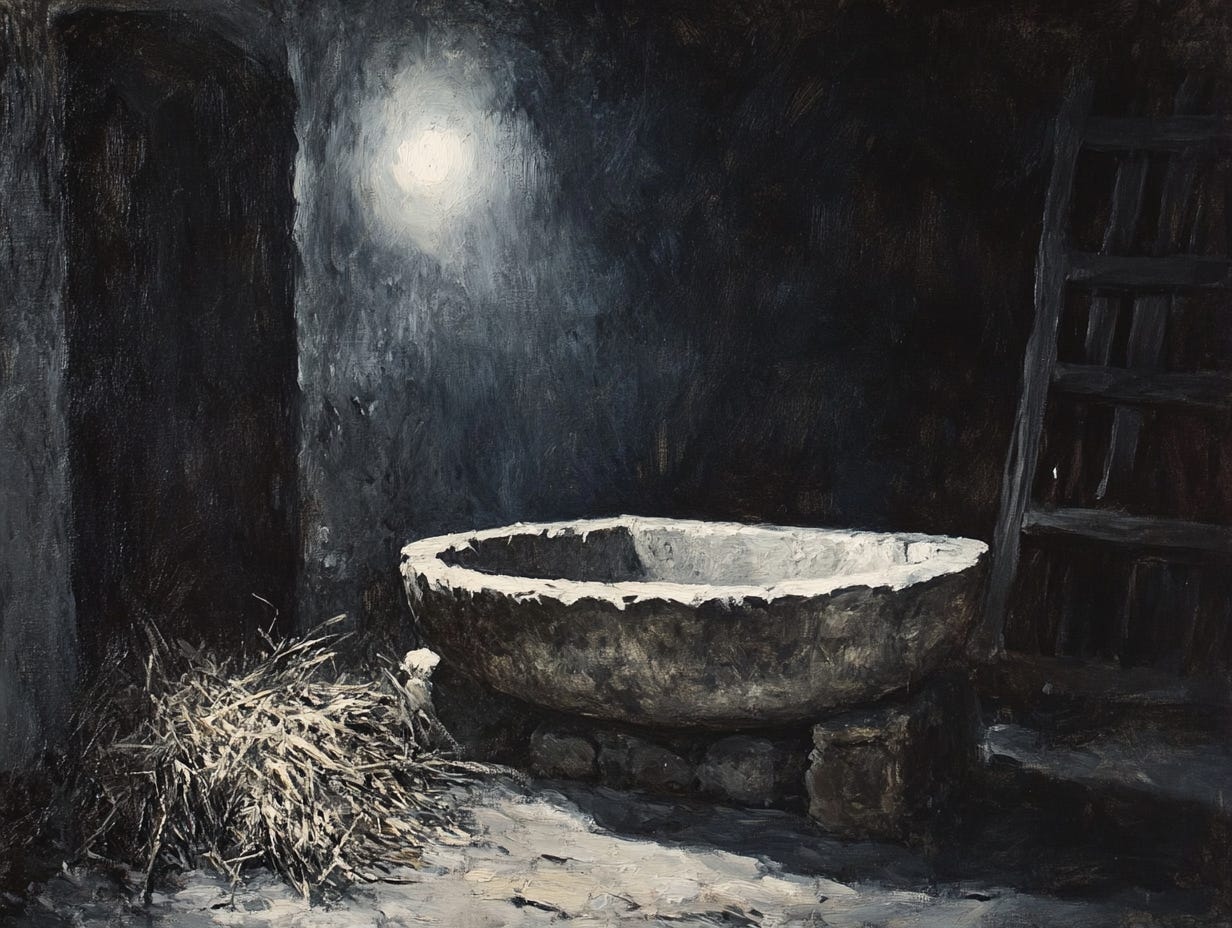
God had every resource of divinity—omnipotence, omniscience, the infinite abundance of eternal life. If anyone could have hoarded, God could have. If anyone had reason to secure divine prerogatives against uncertain futures, God did.
Instead: a baby in a feeding trough.54
God emptied. God vulnerable. God so committed to being with us that divine power was set aside, divine protection abandoned, divine distance collapsed into the intimate helplessness of an infant who couldn’t survive an hour without human care.55
This is not God fixing our problem from outside. This is God entering our condition from inside. Not working for us but being with us.56 Not solving our scarcity but sharing our vulnerability. Not distributing resources from above but becoming one of the ones who needs resources from below.
Here’s the Christmas truth the neuroscience confirms: you can’t heal firmware problems with software updates.57 You can’t think your way out of shame. You need presence—regulated nervous systems co-regulating dysregulated ones over time. The Incarnation isn’t a doctrinal solution to a conceptual problem. It’s God’s entry into the co-regulatory circuit. Emmanuel—God with us—isn’t just theology. It’s the neurobiological reality of healing: presence that holds us until our own systems can reorganize.
The theology I inherited taught me that Christmas was about transaction—humanity owing a debt we couldn’t pay, God sending Jesus to satisfy the divine requirement.58 But the more I sit with this, the more I suspect it mistakes not just the emphasis but the entire framework.
The problem isn’t that transactional theology gets the payment wrong. The problem is that debt, payment, and satisfaction are the wrong categories altogether.59 In that framework, God is the problem—offended honor requiring satisfaction. But in the story Luke tells, God is the solution—the one who invades territory occupied by hostile powers and liberates the captives.
Listen again to Jesus in Nazareth: “release to the captives, liberty to the oppressed.” That’s not payment language. That’s liberation language. Exodus language. The Incarnation isn’t God collecting what we owe. It’s God entering Pharaoh’s territory to set prisoners free.
The Incarnation isn’t primarily about God doing something for us. It’s about God being with us.60
Emmanuel. God with us61—in the mess, in the vulnerability, in the precarity that the powerful have always imposed on the displaced. Mary and Joseph were displaced people. Pushed by imperial census to a town that had no room for them.62 They were the ancient equivalent of refugees, migrants, the economically marginal people that empires shuffle around for administrative convenience. And God chose to be born among them. Not despite their marginality but into it.
The manna kept with the Word didn’t rot because it had been released.
Given over. Offered. Placed in the Ark not as private asset but as public witness. It remained sweet because it wasn’t clutched.
What if we released?
But I need to acknowledge something. “What if we released?” assumes you’re holding something.63
For many, the question lands differently. If you’ve never been sure you had a right to hold anything—if you’ve spent your life proving you deserve a place at the table, if your family’s accumulation was survival rather than greed, if you’ve been the perpetual foreigner never quite belonging to the fantasy—then “release” might sound like another demand from people who’ve always had enough.
The hoarding economy forms different people differently. Some it teaches to clutch from abundance, terrified of losing status. Others it teaches to clutch from precarity, desperate to finally have enough to belong. The manna story speaks to both, but differently. For the abundant, the word is: let go, your store-cities are rotting, there’s bread tomorrow. For the precarious, the word might be: you don’t have to earn your place, the manna was there before you gathered, you belong before you produce.
Same economy. Same table. Different paths to arrive there.
Not naive release that ignores genuine vulnerability. The people I know who are genuinely precarious don’t need lectures about letting go of wealth; they need the wealth that others are clutching.64 But those of us who are clutching—those of us with more than enough, whose anxiety about scarcity isn’t rational assessment but inherited formation—what if we practiced releasing?
We are not yet that people. I am not that person. The distance between here and there stretches farther than I can see.
But the direction is clear. And Christmas invites us to take a step.

Benediction
So this Christmas, remember the manna—that it rotted when hoarded and stayed sweet when offered. Remember Mary singing reversals in the prophetic perfect tense. Remember Emmaus, where recognition came not in the teaching but in the practice. Remember the Word made flesh, who held nothing back.
The manna we keep is the manna we release.
Go and do likewise. Not perfectly. Not all at once. But in the direction of release.
May the God who became flesh and dwelt among us teach you, by presence, what no theology could convey:
You are not alone.
You have enough.
You can let go.
Amen.
CODA
The Series
This essay belongs to Jazz, Shame, and Being With—a twenty-essay arc tracing shame and pride from neurobiology through theology to political formation. If you’ve been reading along, you know where we’ve been. If you haven’t, or if you’d like to see the architecture of where this is heading, the Reader’s Guide maps the full journey. Every essay is a real door. Start anywhere that calls to you.
The Appendix
For those who want the deeper ontological scaffolding beneath this essay—the philosophical grammar of participation, gift, and presence that distinguishes incarnational theology from its counterfeits—I’ve written a companion piece:

If you found yourself wanting to know why the manna-with-the-Word didn’t rot—not just that it didn’t—that’s where I trace the logic.
With open hands and steady presence,
Craig
Christmas 2025
Exodus 16:32-34.
Hebrews 9:4. The Ark contained “the golden urn holding the manna, and Aaron’s rod that budded, and the tablets of the covenant.” These three objects constitute what Stephen Chapman calls a ‘witnessing apparatus.’ Each counters an aspect of imperial power: the tablets counter propaganda with truth; the rod that budded counters dominating authority with life-giving leadership (Numbers 17:1-11 shows Aaron’s rod blooming with almonds while the rods of rivals remained dead); manna counters extraction economy with gift economy. Together they witness to a different kind of power than Pharaoh’s—Word rather than propaganda, authority that gives life rather than death, provision that circulates rather than accumulates. The Ark carried Israel’s portable counter-testimony against empire.
The tradition calls manna “bread from heaven”—lechem min hashamayim(Exodus 16:4). That phrase echoes through Israel’s memory, reappearing whenever the community remembers wilderness provision (Nehemiah 9:15; Psalm 78:24). By the time we reach John’s Gospel, Jesus will claim to be the true bread from heaven, the manna that doesn’t run out (John 6:31-35)
John 1:46.
Luke 1:51-53 (NRSV).
The term appears in prophetic literature where future events are described using past-tense verbs to express certainty of fulfillment. Alan Streett compares this to “We Shall Overcome”—assuring both victims and activists that freedom “was on the horizon, but not yet achieved.”
Luke’s first mention of “the rich” (ploutountas) comes in Mary’s Magnificat (1:53), establishing the economic justice theme that threads throughout his Gospel.
Luke 4:18-19, quoting Isaiah 61:1-2.
The Jubilee legislation (Leviticus 25) mandated a fiftieth-year restoration: debts cancelled, slaves freed, ancestral land returned. Jesus’s quotation of Isaiah 61 uses explicit Jubilee language (”the year of the Lord’s favor”). The Jubilee vision always carried an eschatological horizon—a future God would bring, not just a program we’d implement. Isaiah 61 itself was resistance literature, a vision of restoration written when the return from exile had disappointed and Persian overlords still ruled. Sabbath economics isn’t just ancient policy we’ve failed to adopt. It’s hope we’re invited to embody provisionally while we wait for the fullness that only God can bring.
This distinction draws on Samuel Wells’s framework distinguishing God’s “being with” from “working for” or “being for.” The Incarnation is not primarily instrumental (God accomplishing something for us) but relational (God being present with us). See Samuel Wells, Constructing an Incarnational Theology: A Christocentric View of God’s Purpose (Cambridge University Press, 2025), 85–103; and A Nazareth Manifesto: Being with God (Wiley-Blackwell, 2015) for the original development of the framework.
John 1:14. The Greek skēnoō (literally “to pitch a tent” or “tabernacle”) echoes Israel’s wilderness Tabernacle—the place where manna was kept with the Word.
Luke 24:21.
Luke 24:25-26.
Ched Myers calls the Emmaus road encounter “the church’s first catechism”—the template for how Christians should read scripture through the lens of Jesus’s ministry, death, and resurrection. See Ched Myers, Healing Affluenza and Resisting Plutocracy: Luke’s Jesus and Sabbath Economics (Cascade Books, 2025), Chapter 3.
See Ched Myers, Healing Affluenza and Resisting Plutocracy: Luke’s Jesus and Sabbath Economics (Cascade Books, 2025), Chapter 2. On the Jewish roots of catechesis, see Kaufmann Kohler and E. Schreiber, “Catechisms,” Jewish Encyclopedia (New York: Funk & Wagnalls, 1901–1906).
Exodus 16:18.
Egypt’s “store-cities” (Exodus 1:11) represented the imperial economy Israel was leaving behind—an economy of extraction and accumulation built on slave labor. The manna instructions directly counter this formation.
Exodus 16:22-30. The Sabbath instruction comes before Sinai, establishing rest as foundational to Israel’s identity rather than merely one commandment among others.
The placement of Sabbath instruction in Exodus 16—before the giving of the Law at Sinai in Exodus 20—is exegetically significant. Israel’s formation begins with receiving, not achieving. This sequence undermines any reading of Sabbath as reward for obedience; it is instead the precondition for covenantal life.
Sabbath economics encompasses the weekly Sabbath (Exodus 20:8-11), the sabbatical year (Exodus 23:10-11; Leviticus 25:1-7), and the Jubilee (Leviticus 25:8-55). Together they constitute what the tradition calls the "Sabbath principle"—the insistence that accumulation has limits and that redistribution has rhythms.
Genesis 1:31; 2:1-3. The Hebrew tov (good) suggests completeness, delight, sufficiency. Creation doesn’t need human improvement; it needs human enjoyment and care.
Leviticus 25:1-7.
Leviticus 25:8-55. Jubilee addresses the debt-default mechanism by which wealth concentrates over time: families fall into debt, lose land, become tenant farmers or slaves on land that was once their own. Jubilee interrupts this spiral.
Luke 4:18-19. The phrase “the year of the Lord’s favor” (eniauton kyriou dekton) directly echoes Jubilee language.
Luke 4:1-13. The verbal and thematic connections between Jesus’s wilderness temptation and Israel’s wilderness wandering are extensive. N.T. Wright argues that Jesus is recapitulating Israel’s story, succeeding where Israel failed, and thereby qualifying to lead a ‘new exodus.’ Luke uses the word exodos (exodus) at the Transfiguration (9:31) to describe what Jesus would ‘accomplish’ in Jerusalem—his death and resurrection as liberating departure. See N.T. Wright. 1996. Jesus and the Victory of God. Christian Origins and the Question of God 2. Fortress Press, 457-463.
Luke 24:16, 32.
Luke 24:29.
Luke 24:30-31.
Recognition through embodied practice rather than conceptual explanation aligns with what neuroscience describes as right-brain-to-right-brain attunement. The disciples’ hearts burned during the Bible study, but recognition required presence, not proposition. This is how shame heals: not through better ideas but through sustained “being with” that shifts the nervous system from threat to safety. On the neuroscience of co-regulation and Paul’s language of Christ “formed in you” (morphoō—to shape or pattern through relational presence), see the Appendix, “Formation as Co-Regulation.”
Luke 24:35. The disciples return to Jerusalem and report “how he had been made known to them in the breaking of the bread.” Luke demonstrates this ecclesially in Acts 2:44-45 and 4:32-35, where the community formed by the risen Jesus practices what they witnessed at Emmaus: “All who believed were together and had all things in common.” The Jubilee announced in Luke 4 reaches its embodied form in the Jerusalem community’s economic practice. C. Kavin Rowe argues that Luke-Acts must be read as unified narrative; the economic vision isn’t incidental but defining. See World Upside Down: Reading Acts in the Graeco-Roman Age (Oxford University Press, 2009).
This is the consistent burden of Stanley Hauerwas’s work: Christianity is not a set of beliefs to be held but a community to be inhabited. The ethics cannot be separated from the ecclesiology. “The church does not have a social ethic; the church is a social ethic”—which means that without the church’s embodied practice, Christian ethics is merely wishful thinking. See The Peaceable Kingdom: A Primer in Christian Ethics(University of Notre Dame Press, 1983), 99-102.
Exodus 1:11. Pharaoh’s store-cities (Pithom and Rameses) were built by Israelite slave labor. They represent the imperial economy of extraction and accumulation—the opposite of manna economics.
Dan Siegel’s concept of the “window of tolerance“ describes the range of arousal within which the nervous system can stay present, flexible, and connected. Trauma and chronic stress narrow this window; safe relationships gradually expand it. Pharaoh’s economy cultivates insecurity, instability, and uncertainty. See The Developing Mind, 2nd ed. (Guilford Press, 2012), 353-355.
Guy Standing coined “precariat” (precarious + proletariat) to name the growing class defined by unstable employment and chronic insecurity. See The Precariat: The New Dangerous Class (Bloomsbury Academic, 2011). What Standing maps economically, this series traces theologically: precarity generates the shame and anxiety that curdle into ressentiment—the resentful rage that seeks enemies rather than solidarity. Pharaoh’s economy doesn’t just extract labor; it produces the wounded pride that makes populist movements across the political spectrum feel like deliverance. Both right and left have learned to redirect the legitimate grievances of the precarious toward fellow sufferers rather than toward the systems that produce their suffering. The scapegoats differ; the dynamic is the same.
Implicit memory—procedural and emotional learning encoded beyond conscious awareness—operates through neural pathways that conscious intention cannot simply override. The prefrontal cortex can recognize a pattern and critique it; it cannot delete the subcortical circuits that fire automatically. This is why “knowing better” so often fails to produce “doing better.” Formation runs deeper than information. On the neuroscience of implicit memory and Paul’s nous (the perceiving, interpreting self that requires embodied renewal), see the Appendix, “Formation as Co-Regulation.”
This is the formation challenge: even after liberation, the habits of Egypt persist. Israel in the wilderness repeatedly wanted to return to Egypt, remembering the food but forgetting the slavery (Exodus 16:3; Numbers 11:5). The neuroscience of shame explains why: shame operates as biological “firmware“ that fires in milliseconds through subcortical systems, while achievement-based healing operates at the cognitive “software” level. You can’t update firmware with software patches. The body that learned scarcity in Egypt needed forty years of daily receiving to unlearn it. See Jessica Tracy and Richard Robins, “The psychological structure of pride: A tale of two facets,” Journal of Personality and Social Psychology 92, no. 3 (2007): 506-525.
Precarity is increasingly understood as a feature rather than a bug of contemporary capitalism. A workforce anxious about job security is a workforce that won’t demand higher wages or better conditions. This is what it means to say precarity is engineered: the insecurity isn’t a policy failure but a policy achievement. On Standing’s analysis and the theological implications, see note 34.
The debt-default mechanism worked as follows: a family facing hardship would borrow against their land. If they couldn’t repay, they would lose the land and become tenant farmers on what was once their own property. Over generations, this transferred land from many small holders to few large landowners—creating the latifundia (landed estates) that dominated the ancient Mediterranean economy.
Isaiah 3:14-15.
Isaiah 5:8. This oracle directly addresses the land concentration that Jubilee was designed to prevent. The “joining of house to house” describes exactly the process by which debt transferred property from peasant families to wealthy creditors across generations—until “there is no more room” for ordinary families in their own land.
Amos 8:4.
Jeremiah 34:8-22. The passage explicitly connects the failure to release slaves during the Sabbath year with the coming destruction of Jerusalem.
1 Kings 9:19. Solomon built “storage cities” (ha’arei hamiskenot)—the same Hebrew term used for Pharaoh’s store-cities in Exodus 1:11. The verbal echo is suggestive: Israel has become what it fled. Walter Brueggemann’s work on ‘the liturgy of abundance versus the myth of scarcity’ illuminates this pattern. See The Prophetic Imagination, 2nd ed. (Fortress Press, 2001).
Global GDP statistics and wealth concentration data support this claim. The United States holds approximately 30% of global wealth while comprising about 4% of global population.
The United States is unique among wealthy nations in treating healthcare primarily as a market commodity rather than a public provision. The policy choice is made visible by comparison with peer nations who have chosen differently.
Jonathan Levy defines capital not as accumulated wealth but as a psychologically-mediated, future-oriented process with an inherent “liquidity preference”—a structural drive toward optionality and exit rather than commitment and fixity. This isn’t analogy; it’s structural analysis. Both capital and Pharaoh’s economy require subjects formed for scarcity, suspicious of solidarity, convinced that security comes from accumulation. See Jonathan Levy, Ages of American Capitalism (Random House, 2021); for the theological implications, see the Appendix, “Capital as Counter-Manna.”
David Bentley Hart reveals the paradox at capitalism’s heart: capital’s drive toward borderless mobility creates instability that only sovereign states can manage, but state sovereignty requires territorial boundaries. The most mobile capital paradoxically requires the most fixed borders. See David Bentley Hart, “Notes Toward a Polyphonic Politics—Part the Second,” Leaves in the Wind (Substack), December 15, 2025; for the full analysis, see the Appendix, “Borders as Ontological Fiction.”
Hart draws on Marx’s analysis of how national identity functions as a “fantasy of belonging”—shared ethnic/national identity creating the illusion of common interest between exploiter and exploited, redirecting hostility away from systems and toward fellow sufferers. The shame-pride framework illuminates why this fantasy proves so powerful: economic precarity generates shame; shared ethnic identity offers hubristic pride as counterfeit remedy. On this dynamic operating at collective scale, see the Appendix, “The Fantasy of Belonging.”
The historical entanglement of American Christianity with American capitalism is extensively documented. From the Protestant work ethic to prosperity gospel, American Christianity has frequently provided theological legitimation for economic arrangements that contradict biblical economics.
Ched Myers notes that in the wilderness catechism, your portion is explicitly not a function of your gathering: “Those who gathered much had nothing over, and those who gathered little had no shortage” (Exodus 16:18). This directly contradicts the “producer/taker” segmentation pervading contemporary discourse. The wilderness catechism teaches that the distinction between “makers” and “takers” is Pharaoh’s lie, not God’s truth. On how Paul’s baptismal vision extends this economic logic to ethnic identity, see the Appendix, “Particularity and Solidarity.”
The prophetic critique of idolatry consistently connects false worship with economic injustice. The gods Israel was tempted to serve—Baal, Molech, Mammon—all promised prosperity in exchange for practices that violated Torah’s economic vision. The Hebrew chatat carries relational weight that ‘sin’ in English often loses. To sin is to breach covenant, to fail the relationship, to miss what faithfulness required. The prophetic critique of economic injustice isn’t merely ethical concern but covenantal outrage—Israel is betraying the God who delivered them from exactly this kind of economy.
Zechariah 1:3; Malachi 3:7. The prophetic pattern consistently pairs judgment with invitation to return.
Exodus 16:32-34. The manna is kept “before the LORD” and “before the covenant” as witness to future generations.
Luke 2:7. The Greek phatnē refers to a feeding trough for animals—the humblest possible beginning.
Philippians 2:6-8 describes Christ as one who “did not regard equality with God as something to be exploited, but emptied himself, taking the form of a slave, being born in human likeness.”
Samuel Wells distinguishes between “working for,” “working with,” “being for,” and “being with” as modes of engagement. The Incarnation represents God’s definitive choice of “being with”—presence that doesn’t require fixing, solidarity that doesn’t demand improvement as its condition.
Stephen Porges’s Polyvagal Theory describes co-regulation as the process by which one regulated nervous system helps another nervous system regulate. It is not metaphorical but biological. The Incarnation understood through this lens is God entering the co-regulatory circuit—Emmanuel as neurobiological reality, not merely theological affirmation. See Porges, Stephen W. The Polyvagal Theory: Neurophysiological Foundations of Emotions, Attachment, Communication, and Self-regulation. New York: W. W. Norton & Company, 2011.
Douglas Campbell’s critique of ‘contractual’ or ‘transactional’ readings of Paul applies equally to how we read the Incarnation. The apocalyptic framework sees God invading the territory occupied by Sin, Death, and enslaving powers—not settling accounts with a creditor. The difference is enormous: in the contractual model, God’s wrath is the problem requiring solution; in the apocalyptic model, God’s love is the solution invading the problem. See Beyond Justification: Liberation, Participation, and Belonging in Paul’s Letters (Eerdmans, 2020), especially Part Two on the apocalyptic gospel versus contractual frameworks.
Transactional atonement theology—often called “penal substitutionary atonement”—became dominant in Western Christianity, particularly after Anselm’s Cur Deus Homo (1098). While containing important insights about sin’s seriousness, it can obscure the relational and participatory dimensions of salvation.
Eastern Christian theology has long emphasized “theosis” or “deification”—salvation as participation in divine life rather than merely forensic acquittal. This tradition reads the Incarnation as God joining humanity so that humanity might share in God’s life. See Samuel Wells, Constructing an Incarnational Theology: A Christocentric View of God’s Purpose (Cambridge University Press, 2025), 85–103; David Bentley Hart, The Experience of God: Being, Consciousness, Bliss (Yale University Press, 2013), 127–152.
Matthew 1:23, quoting Isaiah 7:14.
Luke 2:1-7. The census required Joseph to travel to Bethlehem, his ancestral town, suggesting he had been displaced from his family’s original landholding—possibly through the debt-default mechanism that transferred land from peasant families to wealthy creditors.
Jonathan Tran’s work on belonging and Asian American experience illuminates how the ‘fantasy of belonging’ operates differently for those racialized as perpetual foreigners. The model minority myth, for instance, is a form of conditional inclusion—you can almost belong if you work hard enough, produce enough, prove yourself useful enough. This is a different formation than the entitled belonging of those who assume their place at the table. Both need the manna economy, but the path into it differs. See Asian Americans and the Spirit of Racial Capitalism (Oxford University Press, 2021).
This is where the prophetic word becomes practical—but carefully differentiated based on actual circumstance. The call to release operates differently depending on whether one is clutching from abundance or barely holding on from precarity.